*please scroll down for text in English*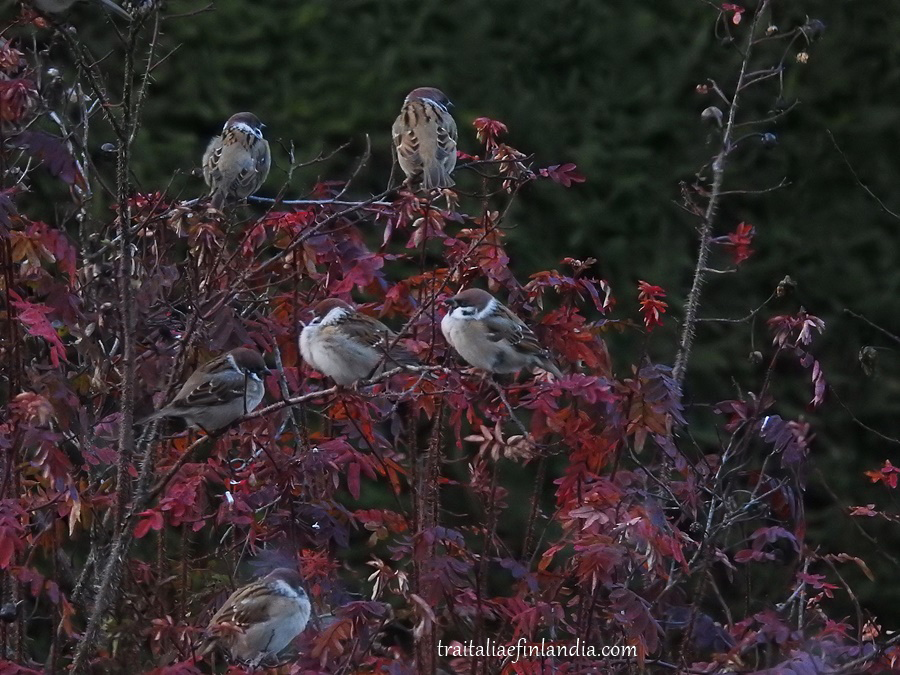
All’inizio di novembre, come vi avevo spiegato QUI, mettiamo fuori le casette di legno con i semi vari per gli uccellini che non migrano e hanno bisogno di reperire cibo facile per far fronte al lungo inverno.
Nostri clienti abituali sono cince e cinciarelle, zigoli gialli, ciuffolotti, codibugnoli… ma anche questi passerotti che si chiamano Passera Mattugia (Passer montanus); in finnico: Pikkuvarpunen. Sono diversi dai loro parenti cittadini, che vedo abitualmente a Verona, a cominciare dal fatto che sono leggermente piu’ piccoli.
Anche i colori del loro piumaggio sono diversi, ad esempio hanno una graziosa macchia nera ai lati del becco. Nelle mie foto li vedete appollaiati su alcuni rosai, le cui foglie in questa stagione diventano piacevolmente rosse e le cui bacche sono particolarmente decorative.
Nello scatto qui sotto: durante un giorno di pioggia, un passerotto si e’ riparato sotto la casetta… furbo! 😉

Sparrows.
When November starts we always hang out in our garden a couple of birds’ feeders for those birds who do not migrate and need to find easy food to survive in the long winter. As I explained HERE.
Our usual customers are Blue tits, Great tits, Eurasian bullfinches, Long-tailed tits, Yellowhammers… as well as this type of sparrow in the shots above, called: Eurasian tree sparrow (Passer montanus); in Finnish: Pikkuvarpunen.
The Eurasian tree sparrow is different from the common sparrow I usually see in Verona: its dimensions are slightly smaller and the plumage differs in colours – this has a small back spot on both sides of its muzzle, for instance. In thses photos you can admire them sitting on our rosebushes: pleasantly red leaves and berries give a touch of colour to the garden in this gloomy season.
In the last shot: a sparrow finds shelter under a feeder during a rainy day… clever! 😉
****
 Tra Italia e Finlandia
Beautiful Sparrow pictures
"Mi piace"Piace a 1 persona
Tres interessant! Merci
"Mi piace"Piace a 1 persona
Tout à fait magnifique ! Bonne journée
"Mi piace"Piace a 1 persona
I love bird watching and it’s great to give the little ones a bit of winter help.
"Mi piace"Piace a 1 persona
Che meraviglia e che tenerezza
"Mi piace"Piace a 1 persona
Deliziosi!!!
"Mi piace"Piace a 1 persona
Adorabili creature. 😀
"Mi piace"Piace a 1 persona
Beautiful photos!
Here are lots of rowans and when the temperature went below zero, varpuset went wild 😀 It took only a couple of days to empty the trees from berries. The ground was so red!
"Mi piace"Piace a 1 persona
Schöööön.
Feldsperlinge sind selten geworden
Haussperlinge auch.
Spatzen sind meine Lieblingsvögel
Liebe Grüße Brigitte
"Mi piace"Piace a 1 persona
Aveva evidentemente dimenticato l’ombrello.
"Mi piace""Mi piace"
Dann musst du unbedingt nach Finnland kommen, Brigitte, hier sind noch welche…😉🐦🐦🐦🐦🐦
"Mi piace"Piace a 1 persona
Poor little hungry birds…
"Mi piace"Piace a 1 persona
Grazie Luisa. 😊
"Mi piace"Piace a 1 persona
Proprio teneri. 🐦
"Mi piace""Mi piace"
Yes, we like to do that too.
"Mi piace"Piace a 1 persona
Merci et bonne journée Georges!
"Mi piace"Piace a 1 persona
Merci. 😊
"Mi piace"Piace a 1 persona
Thank you.
"Mi piace"Piace a 1 persona
Nice post! Thanks
"Mi piace""Mi piace"
Okay, ich liebe Finnland ja sowieso sehr 🥰
"Mi piace""Mi piace"
We used to see these sparrows everywhere, both in the countryside and in the cities. This is very different now. They have completely disappeared in cities and their numbers have also declined elsewhere. Probably due to a lack of food as a result of the noticeably smaller number of insects compared to before…
"Mi piace"Piace a 1 persona
This is a pity indeed. Many species are in danger, at many levels in different parts of the world…😔
"Mi piace"Piace a 1 persona
Lovely shots of the sparrows and berries!!
"Mi piace"Piace a 1 persona
…I enjoy watching birds come to the feeder.
"Mi piace"Piace a 1 persona
Meravigliosi loro e meravigliosa tu che ti prendi cura di loro.
"Mi piace"Piace a 1 persona
È molto bello guardare gli uccelletti che si danno da fare intorno al cibo. Io nutro i passerotti di città e le cornacchie (che io chiamo corvi perché mi sembra non offensivo). Fischio e loro arrivano gracitando ad ali spalancate. I passerotti invece devono competere con i grassi colombi.
Grazie di questo post, Luisella🌹, come di tutti quelli che pubblichi e che ci fanno sentire la dolcezza della natura e quella con cui la curi.
"Mi piace"Piace a 1 persona
Grazie, lo considero mio dovere. 👍😉
"Mi piace"Piace a 2 people
Me too! 😉🐦
"Mi piace""Mi piace"
Sono io che ringrazio te Marcello, per il gentile apprezzamento. Buon pomeriggio! 😊
"Mi piace"Piace a 1 persona
Such lovely birds!
"Mi piace"Piace a 1 persona
Buona notte, Luisella🌹. Grazie della tua gentile risposta🙏🌹
"Mi piace"Piace a 1 persona
Oh yes, they are. 😊
"Mi piace"Piace a 1 persona
bellissime immagini 👏👏👏👏👏👏👏👏👍😊
"Mi piace"Piace a 1 persona
Grazie Max. Gentilissimo come sempre. Buona giornata! 🌈
"Mi piace"Piace a 1 persona
..beautiful photos of the birds
have a nice day
"Mi piace"Piace a 1 persona
Very nice photographs of the Sparrows! These are really handsome birds. I know they appreciate the winter food.
"Mi piace"Piace a 1 persona
Woooooow fantastic.
"Mi piace"Piace a 1 persona
They look plump and happy!!
"Mi piace"Piace a 1 persona
Yes, plump they are. 😉😄😄
"Mi piace""Mi piace"
Thank you so much. 😊
"Mi piace"Piace a 1 persona
Thank you and happy weekend! 😊🐦
"Mi piace""Mi piace"
Thank you Willy. You are always very kind. Happy weekend! 🌈
"Mi piace""Mi piace"
Mi piacciono gli uccelli.
Ci sono molti passeri qui a cui do da mangiare ogni giorno.
Saluti Irma
"Mi piace"Piace a 1 persona
Grazie e buon weekend, Irma! 🌈
"Mi piace""Mi piace"
Hello Luisella,
The Tree Sparrows are so cute, I would love to see them more than the House Sparrows we have here. They look well fed and happy. Great photos. Thank you for linking up and sharing your post. Take care, have a great weekend. PS, thank you for leaving me a comment.
"Mi piace"Piace a 1 persona
It’s always a pleasure to see birds up close. Great shots! I’m particularly impressed by the photo of the sparrow taking shelter under the feeder during a rainy day. So clever!
"Mi piace"Piace a 1 persona
Tree Sparrows are lovely birds, sadly they are in heavy decline here in the UK. It’s quite rare to find one these days without going to known sites for them.
"Mi piace"Piace a 1 persona
I am truly sorry to hear that…
"Mi piace""Mi piace"
Thank you so much for your kind comment.
"Mi piace""Mi piace"
My pleasure to take part in your blog party. Happy weekend Eileen!
"Mi piace"Piace a 1 persona