
Come forse ricordate, ho condiviso con voi tempo fa una filastrocca-proverbio tramite il quale la saggezza antica prevede l’arrivo della bella stagione servendosi dell’aiuto degli uccelli migratori:
Kuu kiurusta kesään, puoli kuuta peipposesta, västäräkistä vähäsen, pääskysestä ei päivääkään.
Questa filastrocca significa che le prime ad arrivare sono le Allodole, (di solito a inizio marzo) e indicano che manda un mese alla primavera; poi arrivano i Fringuelli e manca mezzo mese; quindi i Batticoda quando manca poco e infine le Rondini…e ci siamo!
Ma l’articolo di giornale che vi propongo quest’oggi, redatto dal giornalista e scrittore Jouni K. Kemppainen, dice che la filastrocca andrebbe aggiornata, poiche’ altri uccelli hanno iniziato ad arrivare al nord prima del loro solito, dato il cambiamento del clima, e che molti altri decidono sempre piu’ di non migrare.
Per cui Kemppainen propone di aggiungere alla lista il Succiacapre (Kehrääjä), la Quaglia comune (Viiriäinen) e la Cannaiola di Blyth (Viitakerttunen).
Per mia esperienza, per averli visti anche in pieno inverno alle nostre mangiatoie, i Merli sono fra gli uccelli dei quali sempre piu’ individui decidono di non migrare: https://traitaliaefinlandia.com/2022/01/31/la-merla-infreddolita/
Nelle foto seguenti: il Pettirosso appena arrivato si chiede sgomento se non era il caso di aspettare, vista la leggera nevicata di inizio aprile.


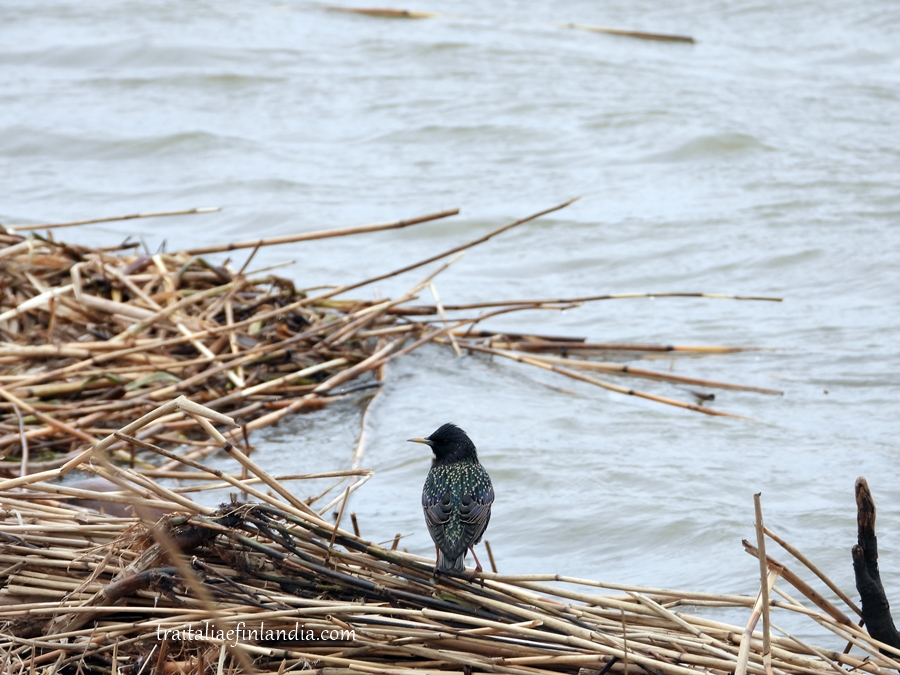
E pure lo Storno sembra a disagio…


Beforehands.
As you may remember, I shared with you some time ago a nursery rhyme-proverb through which ancient wisdom predicts the arrival of the good season by the help of migratory birds: “Kuu kiurusta kesään, puoli kuuta peipposesta, västäräkistä vähäsen, pääskysestä ei päivääkään”.
This nursery rhyme means that the first to arrive are the Larks (usually at the beginning of March) and they indicate that spring will begin in a month; then the Chaffinches, and it is about just half a month; then the White wagtails, when only little time is left and finally the Swallows… and here we are!
But the newspaper article I am proposing to you today, written by journalist and writer Jouni K. Kemppainen, says that the nursery rhyme should be updated, because other birds have started arriving in the north earlier than usual, given the climate change, and that many others are increasingly deciding not to migrate.
So Kemppainen suggests adding the Nightjar (Kehrääjä), the Common Quail (Viiriäinen) and the Blyth’s Reed Warbler (Viitakerttunen) to the list.
In my experience, having seen them even in the middle of winter at our feeders, Blackbirds are an example of birds who decide not to migrate in total numbers: https://traitaliaefinlandia.com/2022/01/31/la-merla-infreddolita/
In my final shots: the newly arrived European Robin wonders in dismay whether it was better to wait, given the light snowfall at the beginning of April.
The Starling seems to be feeling uncomfortable too…
****
 Tra Italia e Finlandia
Blackbirds are so dainty! Thanks for the great information.
"Mi piace"Piace a 2 people
Beat little birds, especially the robin. Thanks for the information. 😊 Cheers.
"Mi piace"Piace a 2 people
* Beautiful little birds. Sometimes, autocorrect isn’t helpful …
"Mi piace"Piace a 2 people
Maybe many other birds which are increasingly deciding not to migrate, heed recent calls to prevent overcrowding of popular tourist destination? Tourists go home, and suchlike?
"Mi piace"Piace a 1 persona
Magnifique série, ils sont beaux ces petits oiseaux. Bonne journée
"Mi piace"Piace a 1 persona
The birds are smart and know exactly when they want to migrate.
Love your sweet Robin! Have a happy day and a blessed Easter week!
"Mi piace"Piace a 1 persona
…I hope that you will have many feathered visitors.
"Mi piace"Piace a 1 persona
Bellissimi uccelli!
"Mi piace"Piace a 1 persona
Fine set of photos! We were by a small lake several weeks ago when it was still cold and snowy. I wondered how the early migrants would do given the temperatures 😏
"Mi piace"Piace a 1 persona
They are brave. 😊
"Mi piace"Piace a 1 persona
Grazie mille, Egidio.
"Mi piace"Piace a 1 persona
That would be great! Thank you Tom. 🐦
"Mi piace""Mi piace"
They are wonderfully, yes. Thank you Eileen. Have a great Easter week too!
"Mi piace"Piace a 1 persona
Merci et bonne soirée. 😊
"Mi piace""Mi piace"
😄😄😄
"Mi piace""Mi piace"
Thank you Lynette. 👍
"Mi piace"Piace a 1 persona
Thank you. 😊
"Mi piace"Piace a 1 persona
Molto interessante!
Dove abito io, i merli non migrano mai, mentre i pettirossi si vedono solo in inverno
"Mi piace"Piace a 1 persona
Interessante…magari i pettirossi sono partiti da qui! 😃
"Mi piace"Piace a 1 persona
😉💕🙏
"Mi piace"Piace a 1 persona
Enjoyed your birds!
"Mi piace"Piace a 1 persona
Thank you. 😃🐦
"Mi piace"Piace a 1 persona