**for English please scroll down**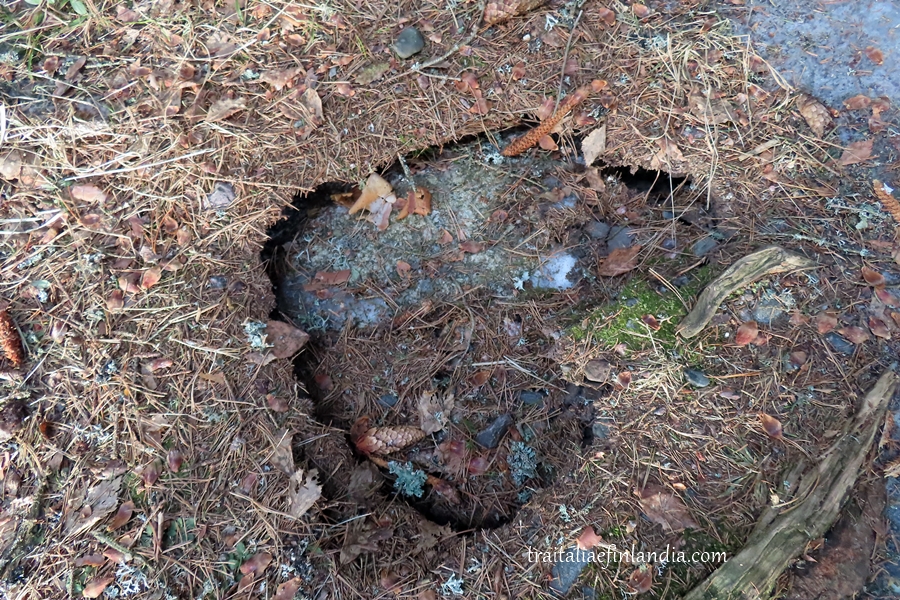

Premessa: l’inverno e’ una stagione costosa, per i finlandesi e per tutti i popoli del nord.
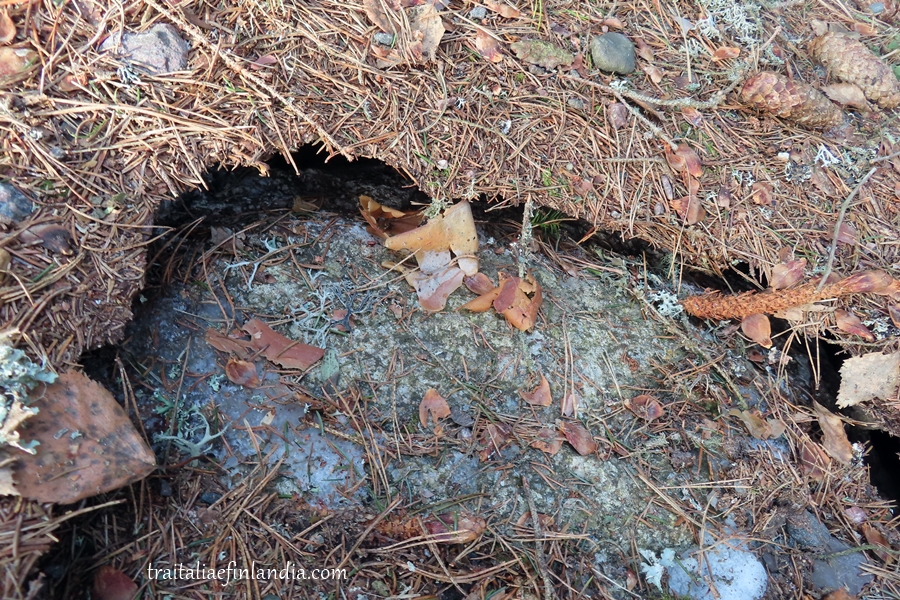
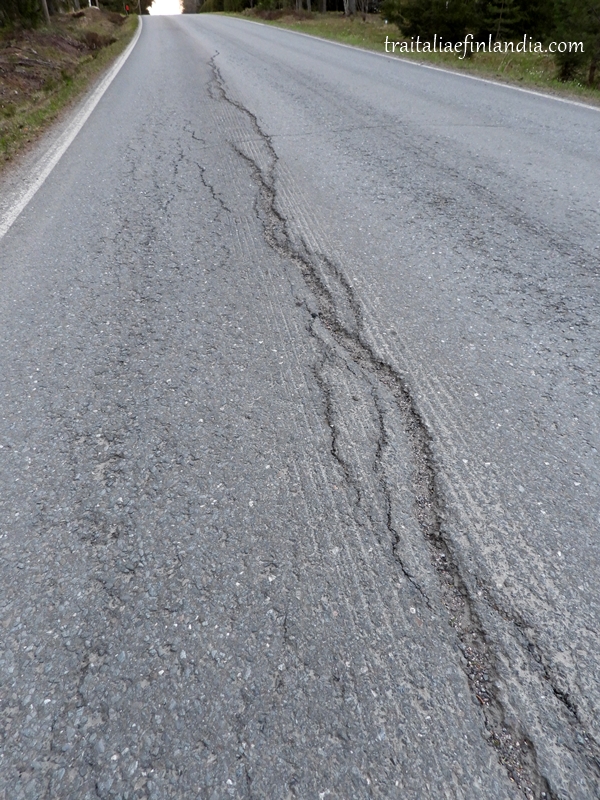
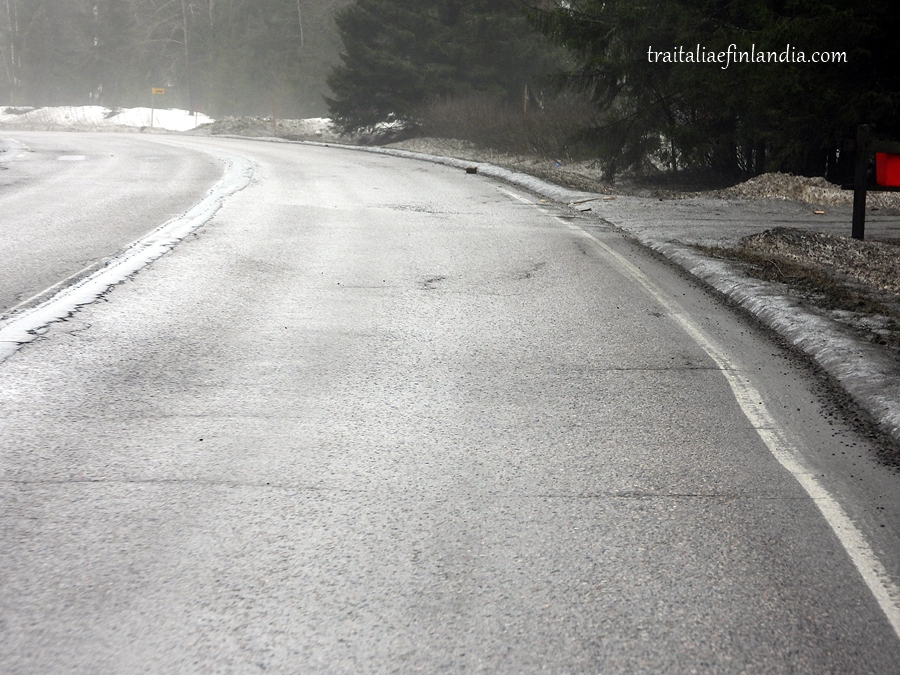
Quello che vediamo nelle foto di oggi e’ il fenomeno che in finnico si chiama: “routa” e che crea disagi in vari contesti, non ultime le strade asfaltate, che richiedono maggiore manutenzione.
E’ presto spiegato: quando il terreno gela in inverno, l’umidita’ in esso contenuta si espande (e’ una caratteristica precisa del ghiaccio) e quando sgela in primavera, lascia conseguenze visibili come dislivelli nel terreno, buche, crepe, dossi…che talvolta si livellano spontaneamente durante la bella stagione e a volte no.

La gravita’ del fenomeno dipende dal tipo di terreno: argilloso, roccioso…ma e’ chiaramente inevitabile. Proprio per questo motivo, tutte le strutture interrate qui al nord sono molto piu’ profonde: le tubature ad esempio sono interrate a 1,80 metri sottoterra, per evitare che vengano raggiunte dal ghiaccio.
Veramente anche le regole su quanto in profondita’ devono essere poste le tubature, dipendono dal terreno e dalla latitudine: piu’ a nord si va, piu’ profonde devono essere.
Infine, un’informazione sopplementare: la costruzione delle strade qui richiede molto piu’ scavo, lavoro e costi, in quanto bisogna andare in profondita’, riempire con vari strati di materiale che facciano drenare l’acqua e finalmente asfaltare. Molto piu’ complicato di quanto sia la costruzione di una strada in Italia, ad esempio.
CURIOSITA’: Prima dell’avvento della dinamite, per spezzare le rocce si usava praticare una serie di fori, riempirli d’acqua e poi mettere un tappo di legno; la forza dell’acqua, gelando, fratturava le rocce, senza che si levasse il tappo.
Routa.
Foreword: winter is a costly season for Finns and for all the Northern countries.
What we see in today’s photos is the phenomenon that in Finnish is called: “routa” and that creates inconveniences in various contexts, not least in asphalt roads, which require greater maintenance.
It is easily explained: when the ground freezes in winter, the humidity contained in it expands (it is a specific characteristic of ice) and when it thaws in spring, it leaves visible consequences such as unevenness in the ground, holes, cracks, bumps… which sometimes level out spontaneously during the good season and sometimes not.
The severity of the phenomenon depends on the type of terrain: clay, rock…but it is clearly unavoidable. For this very reason, all the underground structures here in the north are much deeper: the pipes, for example, are buried 1.80 meters underground, to prevent them from being reached by the ice.
Actually, even the rules on how deep the pipes must be placed depend on the terrain and the latitude: the further north you go, the deeper they must be.
Finally, an additional piece of information: road construction here requires much more work and costs, as it is necessary to excavate deeply, fill with various layers of material to let the water go through, and finally asphalt. Much more complicated than building a road in Italy, for example.
 Tra Italia e Finlandia
Sempre molto interessanti i tuoi post! Buona giornata!
"Mi piace"Piace a 1 persona
Yes, having lived in the subarctic I understand the damage that can happen. Lots of expensive and constant maintenance involved! Interesting post. Cheers.
"Mi piace"Piace a 1 persona
An Interesting observation. Winter damage to roads is know to occur not only in Scandinavian countries, but also in regions with a milder climate. Whether the damage get repaired every year is a different question.
"Mi piace"Piace a 1 persona
Thanks. I know what you mean. For instance in Italy roads get damaged after heavy raining, but I wanted to talk specifically about ice and its dynamics. The road repairing is a totally different question in Italy too…😬
"Mi piace""Mi piace"
I do want to point out how much more expensive is to live in the subarctic. Thank you. 😊
"Mi piace"Piace a 1 persona
Grazie. 😊 Buona giornata Romolo!
"Mi piace"Piace a 1 persona
Le gel et le dégel abîment beaucoup les routes. Bonne journée
"Mi piace"Piace a 1 persona
It is a common sight here, the roads get torn up in the winter, the snow ploughs and salt trucks do a lot of damage. Take care, have a great day!
"Mi piace"Piace a 1 persona
Our life here is that roads are always under construction, year round. Although, our winters have become milder, so I wonder if that will change.
"Mi piace"Piace a 1 persona
Our winters are getting milder too, to tell the truth…
"Mi piace"Piace a 1 persona
True, salt trucks do their part too. Thank you Eileen. Have a happy Wednesday!
"Mi piace"Piace a 1 persona
Oui, ils font beaucoup de dégâts. Merci et bonne journée á toi, Georges!
"Mi piace""Mi piace"
Ho trovato l’articolo davvero interessante, … e affascinante l’utilizzo dell’acqua gelata per spezzare le rocce in passato!
"Mi piace"Piace a 1 persona
Si, vero? Anch’io l’ho trovato affascinante. Grazie Luisa. 😊
"Mi piace"Piace a 1 persona
…here, the roads are a mess. Pot holes are everywhere.
"Mi piace"Piace a 1 persona
The same in my corner of the world!
"Mi piace"Piace a 1 persona
"Mi piace""Mi piace"
Buona giornata!
"Mi piace"Piace a 1 persona
We have similar issues on our roads. “Pot Hole season”, the bridge between winter and spring 😏.
"Mi piace"Piace a 1 persona
vediamo se adesso riesco… avevo scritto che anche noi qui in montagna ⛰️ abbiamo strade piene di crepe fessure e buche per il ghiaccio… buona serata 💙
"Mi piace"Piace a 1 persona
Yes, that’s a common occurrence here, and even more where I grew up in Winnipeg. Maggie
"Mi piace"Piace a 1 persona
Yes, it definitely is in lots of ways.
"Mi piace"Piace a 1 persona
Ehehhhe…qui non ghiaccia, ma l’Italia è campione olimpico di buche.
"Mi piace""Mi piace"
Thanks for sharing your information, Maggie. 😊
"Mi piace"Piace a 1 persona
Oh si…ci credo. 😊
"Mi piace""Mi piace"
‘Pot Hole season’ is a suitable expression.
"Mi piace"Piace a 1 persona
It works like that…
"Mi piace""Mi piace"
Winter is a difficult season…
"Mi piace""Mi piace"
Qui in Liguria le strade si rompono anche senza il gelo, quelle delle tue foto sono le classiche strade che trovi dalle mia parti, e non solo..🤷♂️🙄👏👍
"Mi piace"Piace a 1 persona
Our roads are in bad shape in NY. The temperatures have gone back and forth between cold and warm all winter.
"Mi piace"Piace a 1 persona
It is a common condition to northern areas inhabitants, looks like.
"Mi piace"Piace a 1 persona
Caspita! Grazie Max e buona giornata!
"Mi piace"Piace a 1 persona
Really interesting! I never knew how much the freeze-thaw cycle affects the land and infrastructure up north. The fact that pipes have to be buried so deep is crazy! Also, the fun fact about breaking rocks with frozen water is super cool. Thanks for sharing!
"Mi piace"Piace a 1 persona
Oh, yes. This is how it works here. The climate forces humans to create special structures. Thanks for your interest, Veronica. Happy Thursday!
"Mi piace""Mi piace"
Purtroppo hai sacrosantamente ragione.
"Mi piace""Mi piace"
Roma ormai è famosa ovuque, ma anche qui in Oltrpo non si scherza, c’è gente che ci ha lasciato diversi cerchioni delle auto.
"Mi piace""Mi piace"
Very interesting!
"Mi piace"Piace a 1 persona
I’m sure it is not as bad as where you live though.
"Mi piace"Piace a 1 persona
👋😊
"Mi piace""Mi piace"
Thank you. 😊
"Mi piace"Piace a 1 persona
Verona non e’ affatto immune dal problema…
"Mi piace""Mi piace"
L’Italia è tutta una frana purtroppo.
"Mi piace""Mi piace"
Bisognerebbe fare come fanno qui: recuperare i miliardi di evasione fiscale, cosi’ lo stato avrebbe i soldi per fare tutto.
"Mi piace""Mi piace"