*please scroll down for English version*
Durante una visita alla bellissima città di Trieste, una volta una guida ci disse che a Trieste bisogna camminare con il naso in su (cosa che io faccio da sempre) perchè tutte le statue sono collocate in luoghi in alto.
Ci sono però quattro statue bronzee piuttosto speciali che sono collocate al suolo e sono dedicate a quattro scrittori e poeti che raccontano l’anima letteraria della città.
La prima la vedete qui sopra: si tratta di James Joyce. Esule volontario dalla sua Irlanda, Joyce si stabilì a Trieste e visse qui per molti anni seppur non continuativamente, lavorando anche come insegnante di lingua inglese. A Trieste Joyce finì di scrivere e pubblicò la sua raccolta di novelle Gente di Dublino, la sua opera che preferisco, in particolare la novella: The Dead.
La statua di Joyce è collocata sul Canal Grande, un pittoresco angolo marinaro in centro città.

La seconda statua di cui vi parlo è raffigura lo scrittore Italo Svevo. Triestino di nascita, Svevo fu un pioniere del romanzo modernista e dell’approccio psicanalitico alla descrizione dei personaggi, cosa che lo avvicinò molto alla poetica di Joyce, con cui divenne grande amico. Svevo era di discendenza ebrea-tedesca per parte di padre e italiana per parte di madre e il suo nome era Aron Hector Schmitz, ma assunse lo pseudonimo di: Italo Svevo, per unire le due anime italiana e mitteleuropea da cui era ispirato.
Il suo romanzo più celebre è: La coscienza di Zeno. La statua di Svevo si trova nello storico quartiere di Cavana.
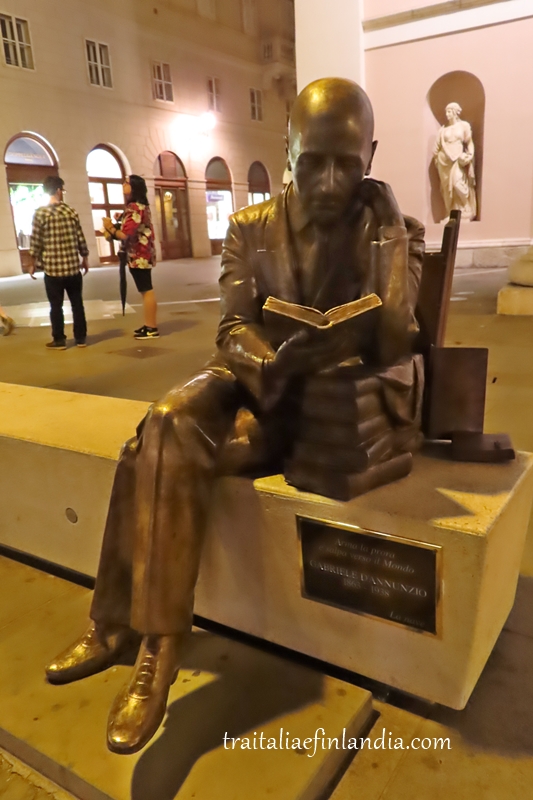
La terza statua bronzea che sono riuscita a fotografare a Trieste ritrae il poeta Gabriele D’Annunzio intento nella lettura. In realtà D’Annunzio fu non solo poeta ma anche drammaturgo, romanziere, politico, giornalista, militare e patriota ed esponente della corrente del Decadentismo di inizio novecento.
Pescarese di nascita, ebbe una vita irrequieta e sempre al limite: personaggio controverso, fu combattente ma anche esteta, autore di pamphlet politici e di liriche immortali. Il rapporto di D’Annunzio con Trieste si estrinseca nell’irredentismo italiano di cui Trieste fu la città simbolo e D’Annunzio il rappresentante più in vista.
La statua di D’Annunzio si trova nella splendida Piazza della Borsa.
La quarta statua che purtroppo non sono riuscita a vedere, è dedicata al poeta Umberto Saba. Triestino di nascita, Saba fu poeta e lirico interessato alle nascenti teorie psicanalitiche e all’introspezione. La sua raccolta più famosa, Il Canzoniere, ci regala componimenti semplici, al limite con l’ermetismo, pieni di riflessioni sulla vita, sul dolore, sulla famiglia, sulla quotidianità e persino sulla Triestina, la squadra di calcio preferita.
La statua di Umberto Saba si trova comunque in via San Nicolò, presso la libreria che lui stesso gestiva.
Three Statues.
During a visit to the beautiful city of Trieste, a guide once told us that in Trieste you have to walk with your nose up (which I have always done) because all the statues are placed in high places. However, there are four rather special bronze statues that are placed on the ground and are dedicated to four writers and poets who will tell you about the literary soul of the city.
You can see the first above: it is James Joyce. A voluntary exile from his native Ireland, Joyce settled in Trieste and lived here for many years, albeit not continuously, also working as an English language teacher. In Trieste Joyce finished writing and published the collection of short stories Dubliners, his work that I prefer, in particular the short story: The Dead.
Joyce’s statue is located on the Grand Canal, a picturesque seaside corner in the city center.
The second statue I’m talking about depicts the writer Italo Svevo. Born in Trieste, Svevo was a pioneer of the modernist novel and of the psychoanalytic approach to the description of characters, which brought him very close to the poetics of Joyce, with whom he became great friends. Svevo was of German-Jewish descent on his father’s side and Italian on his mother’s side and his name was Aron Hector Schmitz, but he chose the pseudonym Italo Svevo, to reunite the two Italian and Central European souls from which he was inspired.
His most famous novel is Zeno’s Conscience, otherwise known as Confessions of Zeno.
The statue of Svevo is located in the historic district of Cavana.
The third bronze statue that I managed to photograph in Trieste portrays the poet Gabriele D’Annunzio intent on reading. Actually D’Annunzio was not only a poet but also a playwright, novelist, politician, journalist, soldier and patriot and a member of the Decadent literary movement of the early twentieth century.
Born in Pescara (in the region Abruzzi), he had a restless life: a controversial character, he was a military officer but also an aesthete, he wrote political pamphlets and immortal lyrics. D’Annunzio’s relationship with Trieste is summarized in the Italian ultranationalism and irredentism (the movement which pretended the unification of geographic areas where the inhabitants were considered ethnically Italian) of which Trieste was the symbolic city and D’Annunzio the most prominent representative.
The statue of D’Annunzio is located in the magnificent Piazza della Borsa.
The fourth statue, which unfortunately I was unable to see, is dedicated to the poet Umberto Saba. Born in Trieste, Saba was a poet and lyricist interested in the new psychoanalytic theories and introspection. His most famous collection, Il Canzoniere, offers simple compositions, bordering on hermeticism, full of reflections on life, sorrow, family, everyday life and even Triestina, his favorite football team.
However, the statue of Umberto Saba is located in via San Nicolò, by the bookshop that he himself run.
****


Che bella Trieste, purtroppo non sono riuscito ancora a visitarla.
"Mi piace"Piace a 1 persona
È proprio splendida. Ero molto curiosa anch’io…
"Mi piace""Mi piace"
Trieste, insieme a Praga e Dublino, è una città della quale mi sono innamorato.
Ho la fortuna di avere una coppia di amici che una tantum vado a trovare… e ogni volta scopro qualcosa di nuovo che mi fa dire “sì, ci vivrei”.
È uno spettacolo incastonato tra mare e montagna.
"Mi piace"Piace a 1 persona
Thank you for sharing the statues and information about these writers and poets who were attracted to Trieste.
"Mi piace"Piace a 1 persona
Tu mi leggi nel pensiero!!!
Sto leggendo Zeno, sto riflettendo sulle analogie con Joyce/Ulysses (un libro SPLENDIDO!), e mi hai fatto venire della statua di Joyce che ho visto e fotografato a Dublino.
Ciao Luisella.
"Mi piace"Piace a 1 persona
Anch’io ce l’ho la foto con la statua di Joyce a Dublino! Un must. 😃Purtroppo molte foto dei miei viaggi sono cartacee…antecedenti alla rivoluzione digitale. Buona giornata!
"Mi piace"Piace a 1 persona
Glad you liked it. Thank you Linda. 😃
"Mi piace""Mi piace"
Devi tornarci.
Dillo a Risto.
Dublino è molto bella.
"Mi piace"Piace a 1 persona
I love those kinds of statues!
"Mi piace"Piace a 1 persona
Bellissime statue in una città favolosa ❤️💙❤️
"Mi piace"Piace a 1 persona
Great statue
"Mi piace"Piace a 1 persona
Trieste è stupenda
"Mi piace"Piace a 1 persona
Ho degli amici a Trieste, prima o poi ci andrò. 😀
"Mi piace""Mi piace"
Hello,
I love all the statues, great photos. Take care, enjoy your day!
"Mi piace""Mi piace"
Thanks for this fascinating post filled with historical information.
"Mi piace"Piace a 1 persona
These statues are magnificent!
"Mi piace"Piace a 1 persona
Thanks for your kind appreciation. 😊
"Mi piace""Mi piace"
…they are the basis of wonderful history lessons.
"Mi piace"Piace a 1 persona
My pleasure. Thanks.
"Mi piace""Mi piace"
Thank you Eileen. I always appreciate your visits and support. All the best!
"Mi piace"Piace a 1 persona
Si, lo è. 👍😊👋
"Mi piace""Mi piace"
Thank you. 😊👋
"Mi piace""Mi piace"
Davvero favolosa. Grazie Luisa. 😊
"Mi piace"Piace a 1 persona
They have a friendly allure…😃
"Mi piace"Piace a 1 persona
Si, verissimo. Siamo stati insieme comunque quella volta. Era il 1997. 😊
"Mi piace"Piace a 1 persona
Sure.
"Mi piace""Mi piace"
You taught me a little about what seems a very beautiful city. I hope we have a chance to visit Trieste some day.
"Mi piace"Piace a 1 persona
👍💙💗
"Mi piace"Piace a 1 persona
bellissima descrizione!
"Mi piace"Piace a 1 persona
These are good statues.
"Mi piace"Piace a 1 persona
J’aime beaucoup vos photos de statues. Merci.
"Mi piace"Piace a 1 persona
Thank you for introducing me to some of the literary figures associated with Trieste. I was familiar with Joyce’s time in Paris but didn’t know that he also lived in Italy for some time.
"Mi piace"Piace a 1 persona
I am happy to hear that I brought something new to you. 😊 Thanks.
"Mi piace"Piace a 1 persona
Merci beaucoup. 😊👋
"Mi piace""Mi piace"
Thank you William.
"Mi piace""Mi piace"
Grazie mille. Mi è piaciuto girare per il Friuli. 😊👋
"Mi piace""Mi piace"
Glad you liked my descriptions. Thank you so much.
"Mi piace""Mi piace"
Trieste è meravigliosa, intrisa di tantissima storia. Amo il suo mare e le sue piazze bellissime e splendenti. Delle mie visite ho sempre con me il suo bellissimo ricordo.
"Mi piace"Piace a 1 persona
È piaciuta molto anche a me e avevo proprio voglia di visitarla. Grazie e buona giornata!
"Mi piace"Piace a 1 persona
Sono innamorato di Dublino e ci tornerò presto.
Però il prossimo anno andremo ancora in Scozia, il mio Paese preferito.
"Mi piace"Piace a 1 persona
La tua descrizione mi trova d’accordo. Trieste è proprio fascinosa. 🙂
Grazie del tuo commento, ho risposto solo adesso perchè era in spam. Buona serata!
"Mi piace""Mi piace"
Anche a me Dublino è piaciuta parecchio. Della Scozia ho visto invece solo Edimburgo.
"Mi piace""Mi piace"
Nice to see these three statues.
All the best Jan
"Mi piace"Piace a 1 persona
Thanks. Glad you liked my post. All the best to you!
"Mi piace""Mi piace"