*please scroll down to find English translation*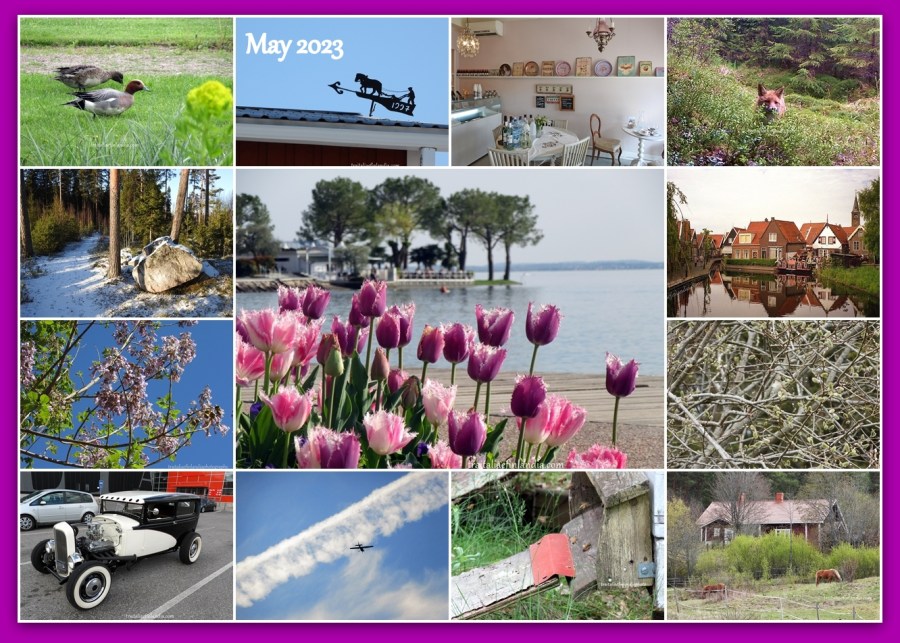 Aprile e’ terminato con una burrascosa ondata di freddo che ha portato venti e qualche episodio di nevischio: dopo il grande caldo delle due settimane centrali, e’ stato davvero strano ritrovarsi al freddo con temperature diurne sugli 8/10 gradi. Naturalmente i riscaldamenti sono rimasti accesi tutto il tempo: le notti sono state vicine o sotto lo zero.
Maggio invece ha portato il sole, il vento da sud e tante giornate bellissime e serene con temperature che hanno facilmente raggiunto i 23 gradi. Siamo cosi’ corsi a spegnere i riscaldamenti, poiche’ le nostre abitazioni che sono interamente in legno, dentro e fuori, si surriscaldano subito. Anche la natura ha goduto del cambio di passo: gli alberi hanno messo le foglie, i primi fiori selvatici hanno mostrato i loro colori lungo le strade, i contadini sono corsi a seminare i cereali primaverili, quelli che non avevano seminato lo scorso autunno. Ricordo che a queste latitudini si fa un raccolto l’anno, non due o tre come in certe zone d’Italia.
La neve di aprile si e’ sciolta tutta velocemente e a meta’ mese abbiamo piantato le patate e seminato spinaci, insalata, rucola e aneto.
La natura adesso va di fretta: deve sviluppare tutto il suo potenziale prima dell’autunno, che qui arriva a fine agosto. Gli alberi, gli animali, l’agricoltura, tutto va veloce perche’ il tempo e’ poco: con l’aiuto della luce anche di notte, le piante vegetano, fioriscono e portano frutti in questa stagione breve; gli animali mettono al mondo i loro piccoli perche’ siano pronti per tempo alla migrazione autunnale; la terra produce cereali e verdure adesso, poiche’ gia’ a fine luglio non avra’ piu’ lo slancio sufficiente. In questo la primavera qui e’ proprio la rinascita della vita, piu’ che in altre latitudini del mondo.
In Italia invece dopo mesi di siccità sono arrivate piogge abbondanti; in particolare una perturbazione che ha stazionato a lungo sull’Appennino emiliano, ha riversato un’enorme quantità d’acqua sull’Italia centrale e sulla regione Emilia-Romagna in particolare. Le conseguenze sono state vaste alluvioni a seguito della tracimazione di ben 21 fiumi, grandi e piccoli; non solo: i fenomeni piovosi eccezionali sono stati ben due a distanza di pochi giorni l’uno dall’altro: in tutto è caduta la pioggia di mesi. Naturalmente le alluvioni hanno provocato danni enormi: città e campagne intrise d’acqua e fango dappertutto, una devastazione che ha fatto perdere moltissimi raccolti e le proprietà e le cose di numerosissime famiglie. Oltre 10 persone hanno addirittura perso la vita.
Le alluvioni sono sempre esisitite, ma gli scienziati, i climatologi, ci dicono che questi fenomeni così consistenti e ravvicinati, alternati a lunghi periodi siccitosi, sono molto più frequenti negli ultimi decenni a causa di una crisi climatica che è ormai evidentissima. Resta il rammarico per quello che si sarebbe potuto fare e non si è fatto per prevenire i danni, dato che tempeste e conseguenti alluvioni si sono succedute perfino negli ultimi mesi in vari posti d’Italia.
Un’altra cosa che continuo a non capire è la difficoltà a trovare i fondi per la ricostruzione, dato che in Italia da sempre abbiamo un’evasione fiscale paurosa. Potremmo avere enormi potenzialità, come Paese, ma siamo schiacciati sotto il peso dei debiti e nessuna parte politica ha mai messo seriamente le mani nel problema. Visto da fuori, l’idea che stiamo dando è di un Paese pieno di contraddizioni.Continuando a dissertare sul fatto se sia buona cosa o meno il far entrare nella nostra lingua parole straniere, voglio ricordare che comunque tante parole italiane spadroneggiano anche all’estero e non piu’ solo quelle strettamente legate all’ambito musicale, ma ultimamente soprattutto al cibo e alla cucina. A parte le piu’ conosciute come “spaghetti”, “cappuccino” e “bolognese”, adesso si usano comunemente anche: “latte”, per indicare semplicemente un bicchiere di latte o di latte arricchito con aromi…ma la piu’ nuova e’: “barista”, che indica un caffe’ fatto a regola d’arte. Nessuno si e’ mai sognato di tradurre queste parole nella lingua locale.
Per non parlare dei marchi di fabbrica, che sempre piu’ spesso usano parole italiane, almeno qui in Finlandia. Alcuni esempi: una nuova struttura per anziani che si chiama: “Nonna”; una catena di calzature si chiama: “Andiamo”; la zona industriale vicino a Turku si chiama: “Avanti”; tante trattorie si chiamano: “Casa Mia”…
Da parecchi anni ormai non sono piu’ stata a Monaco di Baviera, ma transitando spesso dall’aeroporto sento sempre gli addetti che si salutano con: “ciao”, tralasciando il tedesco: “tschüss”.
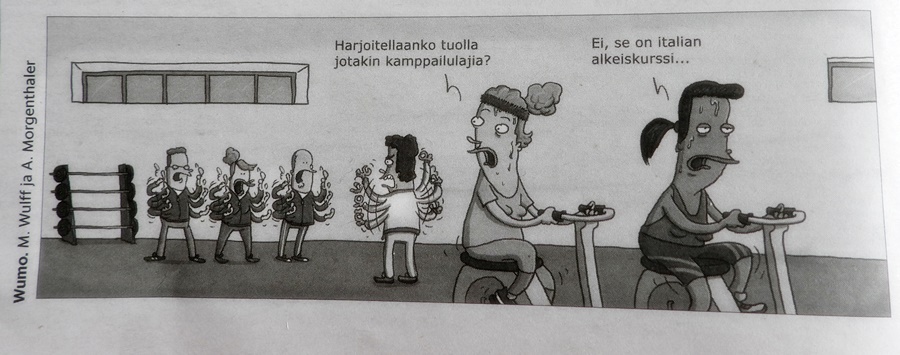
La forma di cominicazione che non siamo ancora riusciti ad esportare e’ comunque la gestualita’: ecco una vignetta vista sul HS recentemente, la battuta dice: “Che fanno laggiu’? Lotta?” “No, e’ un corso di Italiano per principianti”. 😉
La guerra in Ucraina continua con testarda costanza, nonostante i risultati raggiunti da una parte e dall’altra siano insignificanti. Il signor Putin si identifica forse con lo zar Pietro il Grande, che ha condotto una guerra di 21 anni contro la Svezia per conquistare il territorio di San Pietroburgo, infatti sembra ben disposto a continuare l’offensiva: resta da chiedersi quanti cittadini russi ancora andranno a farsi ammazzare per una guerra di conquista che non ha alcun senso. E’ stato calcolato che di questo passo ci metterà 40 anni a conquistare tutta l’Ucraina.
Grazie a tutti voi che mi leggete e benvenuti ai nuovi followers. Buon Giugno!
A Month in my Photos.
April ended with a stormy cold wave that brought winds and some sleet: after the great heat of the two middle weeks, it was really weird to find ourselves in the cold with daytime temperatures around 8/10 degrees Centigrades. Naturally, the heating remained on all the time: nights were close to or below zero.
May, on the other hand, brought sunshine, wind from the south and many beautiful, clear days with temperatures that easily reached 23 degrees. So we hurried to turn off the heating, since our houses, which are entirely made of wood, inside and out, quickly overheat. Even nature has enjoyed the change of pace: trees have put on their leaves, the first wild flowers have shown their colors along the roads, farmers hurried to sow spring cereals, those they hadn’t sown last autumn. I remind everybody that in these latitudes there is one harvest a year, not two or three as in certain areas of Italy.
The snow in April melted quickly and in the middle of the month we planted potatoes and sowed spinach, lettuce, rocket and dill.
Nature is in a hurry now: it must develop its full potential before autumn, which arrives here at the end of August. Trees, animals, agriculture, everything goes fast because time is short: with the help of light even at night plants grow, blossom and bear fruits in this short season; animals bring their offsprings into the world so that they are ready in time for the autumn migration; the earth produces cereals and vegetables now, since by the end of July it will no longer have enough momentum. In this, spring here is precisely the rebirth of life, more than in other latitudes of the world.
In Italy instead, after months of drought, abundant rains have arrived; in particular, a cyclon that stationed for a long time on the Emilian Apennines, poured an enormous quantity of rain onto central Italy and on the Emilia-Romagna region in particular. The consequences were vast floods following the overflowing of 21 rivers, large and small; that’s not all: there were two exceptional rainfall phenomena within a few days: months’ rain fell within hours. Naturally the floods caused enormous damage: cities and countryside drenched in water and mud everywhere, a devastation that caused the loss of many crops and the properties and belongings of many families. Over 10 people even lost their lives.
Floods have always existed, but scientists, climatologists, tell us that these phenomena, so consistent and close together, alternating with long periods of drought, are much more frequent in recent decades due to a climate crisis that is now very evident. The regret remains for what could have been done and has not been done, given that storms and consequent floods have occurred even in recent months in various places in Italy.
What I still don’t understand is the difficulty in finding funds for reconstruction, given that in Italy we have always had a fearful tax evasion. We could have enormous potential, as a country, but we are crushed under the weight of debts and no political party has ever seriously touched the problem. In my opinion we are giving contradictory ideas of our country abroad.
Continuing to argue about whether or not it is a good thing to introduce foreign words into our language, I want to remind my fellow countrymen that in any case many Italian words also dominate abroad and no longer only those closely related to the musical sphere, but lately especially to food and to the kitchen. Apart from the better known ones such as “spaghetti”, “cappuccino” and “bolognese”, now the following are also commonly used: “latte”, to simply indicate a glass of milk or milk enriched with flavorings… but the newer is: “barista”, which indicates a coffee made in a workmanlike manner. No one has ever dreamed of translating these words into the local language.
Not to mention trademarks, which increasingly use Italian words, at least here in Finland. Some examples: a new facility for the elderly called: “Nonna”; a shoe chain is called: “Andiamo”; the industrial area near Turku is called: “Avanti”; many trattorias are called: “Casa Mia”…
I haven’t been to Munich city for several years now, but as I often pass through the airport, I always hear the employees greet each other with: “Ciao”, leaving out the German: “Tschüss”.
The form of communication that we haven’t yet managed to export is gestures: above is a cartoon seen recently on the HS, the joke says: “What are they doing over there? Wrestling?” “No, it’s an Italian course for beginners”. 😉
The war in Ukraine continues with stubborn persistence, despite the fact that the results achieved by both sides are insignificant. Mr Putin perhaps identifies himself with Tsar Peter the Great, (who waged a 21-year war against Sweden to conquer the territory of St. Petersburg), in fact he seems willing to continue the offensive: the question remains how many more Russian citizens will be available to get killed for a war that makes no sense. Experts have accounted how long it will take him to conquer the whole Ukrainian territory: 40 years.
Thanks to all of you who read me and welcome to the new followers. Happy June!
****
 Tra Italia e Finlandia
An Italian course for beginners. 😂
"Mi piace"Piace a 1 persona
Tocchi tantissimi temi.
Riguardo la gestualità italiana… è una cosa molto evidente. Se togli il sonoro alla TV o a internet, vedrai come gli italiani per esprimere un concetto usano moltissimo le mani ed il corpo. Gli inglesi al confronto sono immobili.
Tasse: l’evasione è il vero problema, ed io per motivi lavorativi (che non posso esplicitare) vedo di tutto. Una vergogna totale e continua, spesso legalizzata da leggi che consentono agli imprenditori di tutto.
"Mi piace"Piace a 2 people
I liked the cartoon 🙂
Here in Belgium the month may was dry but cool with winds from the north. Now the last week of may brought us some warmer days but still very windy. The situation in Italy was terrible, we saw images on the news and also the Giro. Nice to read that you had a nice month of may 🙂
"Mi piace"Piace a 2 people
Buongiorno bello
"Mi piace"Piace a 1 persona
❤️
"Mi piace"Piace a 1 persona
Buongiorno grande! 🌞
"Mi piace""Mi piace"
Thanks for your kind comment and for sharing some info. Good day! 🌞
"Mi piace"Piace a 1 persona
Anche i finnici sono del tutto immobili. 😄😄
Tasse: Questo mi fa proprio dispiacere. Senza contare che, dopo aver detto peste e corna della UE, stiamo prendendo soldi dal fondo di solidarietà comunitario…
"Mi piace"Piace a 2 people
😄😄
"Mi piace""Mi piace"
Concordo con il commento di
"Mi piace""Mi piace"
Concordo con il commento di Kikkakonekka sulla gestualità italiana e sull evasione fiscale.
Hai scritto un post particolarmente bello, Luisella. Grazie!
"Mi piace"Piace a 1 persona
Un bel resoconto letto con piacere e curiosità. Ciao Luisella, buona giornata. 🙂
"Mi piace"Piace a 1 persona
Hello,
Beautiful mosaic and images. It is amazing how fast the month of May went by, too fast.
It was a cool spring and kind of dry here. We could use some of that rain. Wishing you a happy new month of June. Take care, enjoy your day!
"Mi piace"Piace a 1 persona
I heard the word “barista” for the first time about 10-15 years ago. Now it has become quite common in American English, and I think it will stay permanently, because there’s no equivalent English word. Coffee shops are more plentiful now than before, so the word is more useful. Plus it’s fun to say. 🙂
"Mi piace"Piace a 1 persona
Thank you for your kind comment, Brad. Nice to hear your point of view. Have a nice day and good coffee!
"Mi piace"Piace a 1 persona
Wishing the same to you Eileen, thanks. Happy June!
"Mi piace"Piace a 1 persona
Grazie mille e altrettanto a te! 🌞
"Mi piace"Piace a 1 persona
Grazie mille, Lara. Mi fa davvero piacere. Buona giornata! 🌷🌻
"Mi piace""Mi piace"
Bellissime immagini e fantastiche riflessioni, Luisella cara🌷🌷🌷
"Mi piace"Piace a 1 persona
Grazie
"Mi piace"Piace a 1 persona
…your May looks beautiful and the car jumped out at me. Enjoy your June.
"Mi piace"Piace a 1 persona
Enjoy your June too, Tom! Thanks. 🌞
"Mi piace""Mi piace"
Grazie Luisa e buon pomeriggio. 🪻🌸🌷
"Mi piace"Piace a 1 persona
The vicissitudes of nature and human nature continue to both perplex and amaze. But it’s comforting to see nature’s beautiful offerings.
"Mi piace"Piace a 1 persona
Auguro un bel pomeriggio anche a te🌷🥰
"Mi piace"Piace a 1 persona
Grazie per i tuoi post e le foto, sempre molto belli.
La vignetta è stupenda!!!
"Mi piace"Piace a 1 persona
Grazie mille. 🪻🌸🌷
"Mi piace"Piace a 1 persona
Grazie.
"Mi piace"Piace a 1 persona
You are right. Nature is a consolation. 🪻🌸🌷
"Mi piace"Piace a 1 persona
Bellissimo maggio 💚
"Mi piace"Piace a 1 persona
Grazie Brigitte. 🪻🌸🌷🏵🌻🌞
"Mi piace"Piace a 1 persona
Our May has been somewhat similar.
"Mi piace"Piace a 1 persona
…not so bad. 🙂
"Mi piace""Mi piace"
Un bel resoconto che ha toccato molti temi interessanti.
Devo ammettere che in passato utilizzavo qualche termine inglese ma adesso sto cercando di evitarlo in tutti i modi dopo aver sentito molti bambini dire “shoppare” invece di comperare, “bro” per chiamare un amico, “crew” invece di gruppo di ballo ecc. ecc.
Come in tutte le cose si passa da un eccesso all’altro.
"Mi piace"Piace a 1 persona
L’importante è poi saperle parlare davvero le lingue straniere, con proprietà e correttezza. Ci aiutano ad aprire la mente. 🙂
"Mi piace""Mi piace"
Heel knappe foto’s
"Mi piace"Piace a 1 persona
🙂👋
"Mi piace"Piace a 1 persona