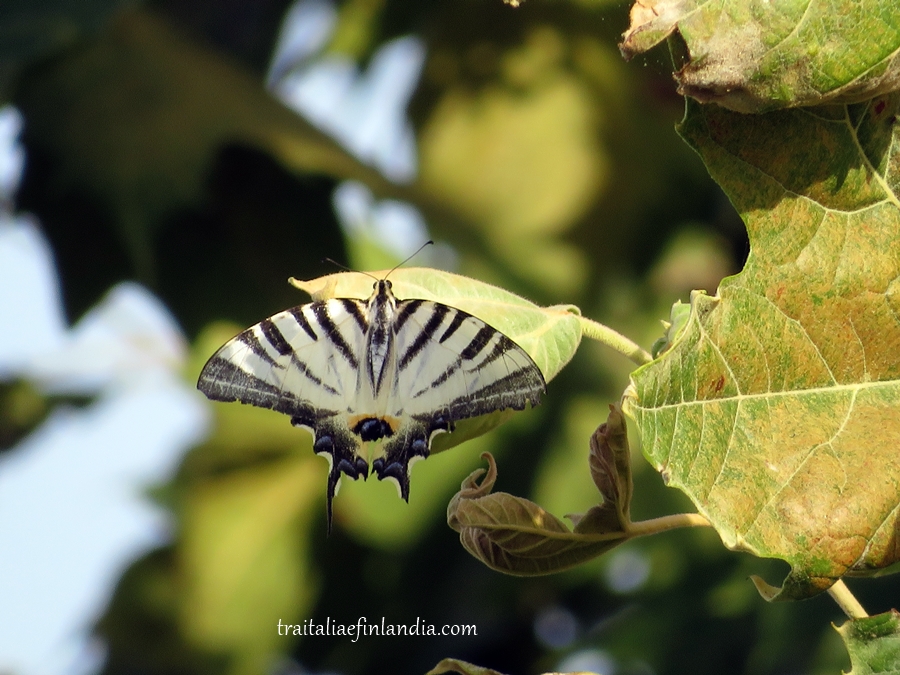
Il Podalirio (Iphiclides podalirius) e’ la bellissima farfalla che ammiriamo nelle mie foto di oggi. Le sue ali sono di un delicato colore biancastro/giallo pallido con strisce nerastre. Alla base delle ali ci sono i famosi “occhi” (ocelli) che aiutano la mimetizzazione. L’apertura alare e’ di 6-8 cm.
Questa autentica bellezza e’ diffusa in Europa, Africa settentrionale, Asia. Essa vive in estate e puo’ avere piu’ generazioni l’anno.
CURIOSITA’: questa farfalla ha questo strano nome, poiche’ e’ strettamente imparentata con il Macaone (Papilio machaon); Macaone e Podalirio erano infatti due fratelli della mitologia greca.
In finnico si chiama: Purjeperhonen.
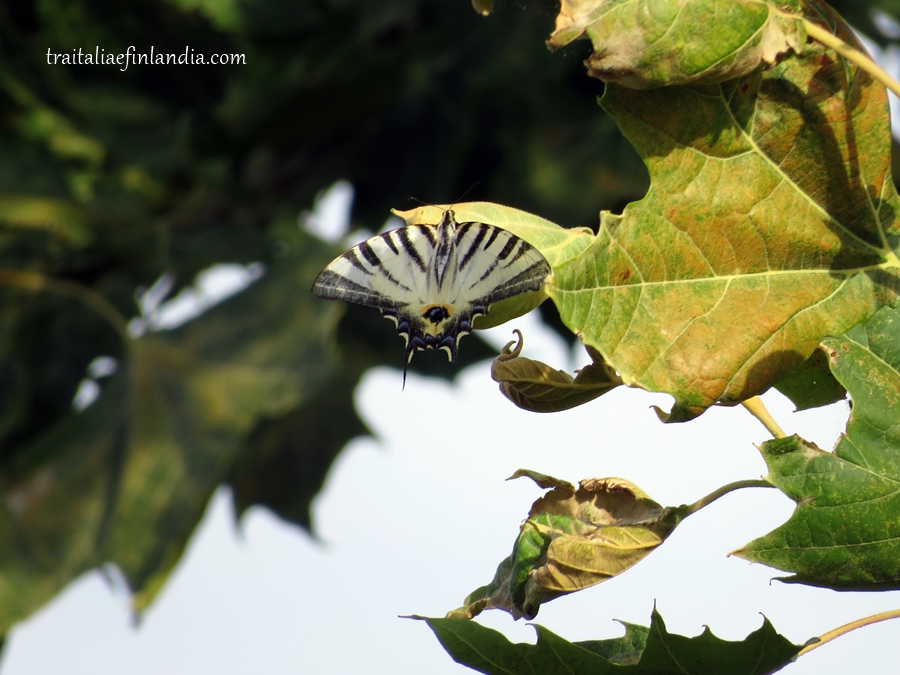

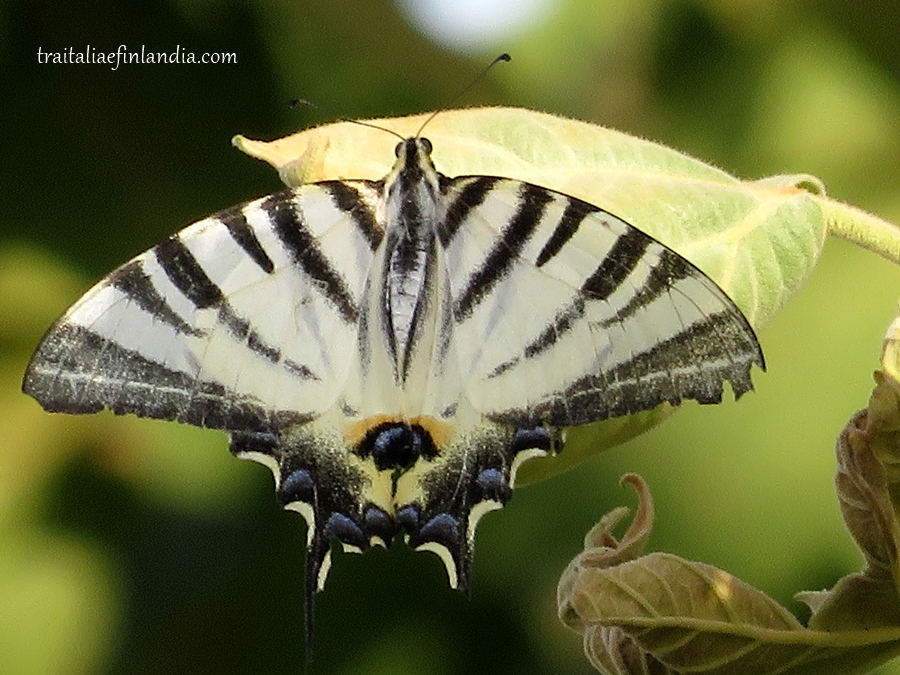
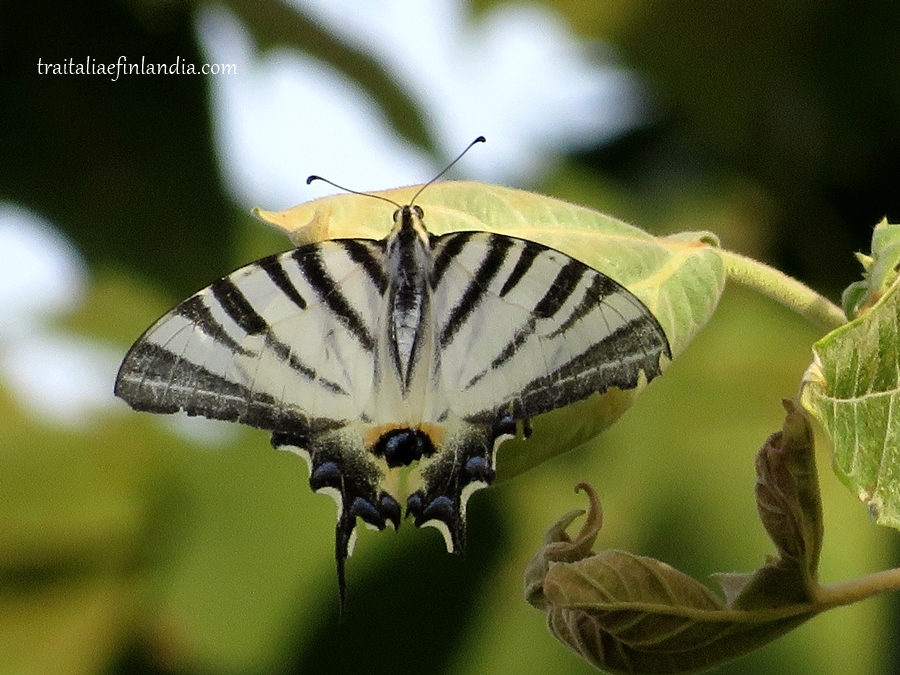
L’individuo che vi propongo ha le ali un po’ lise e le code un po’ danneggiate.
Per chi non lo sapesse, non solo gli ocelli colorati aiutano la mimetizzazione, ma anche le code. Funziona cosi’: i predatori vedono gli ocelli e calcolando la distanza fra di essi decidono che si tratta di un animale di taglia grande, per cui lasciano perdere; le code sono come delle antenne: i predatori allo stesso modo calcolando la distanza fra le due code, deducono che si tratta di un animale grande e lasciano perdere.
Il fatto che gli ocelli e le code siano collocati nella parte meno importante del corpo della farfalla, aiuta la sopravvivenza: se anche i predatori attaccassero, comunque ferirebbero la farfalla in un punto secondario e non sulla testa o sulle vere antenne.
The Scarce Swallowtail.
The Scarce Swallowtail (Iphiclides podalirius) is the beautiful butterfly that we can admire in my photos today. Its wings are a delicate whitish/pale yellow color with blackish stripes. At the base of the wings there are colourful eyespots which help camouflage. The wingspan is 6-8 cm.
This authentic beauty is widespread in Europe, Northern Africa, Asia. It lives in summer and can have several generations a year.
FUN FACT: this butterfly in Italian is called: Podalirio, because it is closely related to the Swallowtail (Papilio machaon) which is called: Macaone; Machaon and Podalirius were two brothers in Greek mythology.
In Finnish it is called: Purjeperhonen.
The individual I am proposing has slightly worn out wings and slightly damaged tails.
For those who do not know, not only do the colored eyespots help camouflage, but also the tails. It works like this: predators see the eyespots and by calculating the distance between them they decide that it is about a large animal, so they give up; the tails are like antennae: predators in the same way by calculating the distance between the two tails, deduce that it is about a large animal and give up.
The fact that the eyespots and tails are located in the least important part of the butterfly’s body helps survival: even if predators attacked, they would still injure the butterfly in a secondary point and not on the head or the real antennae.
****
 Tra Italia e Finlandia
Butterfly camouflage is amazing. Very pretty; thanks for sharing your photos. 😊
"Mi piace"Piace a 1 persona
🧡 🦋 🧡
"Mi piace"Piace a 1 persona
Elle a de belles couleurs de camouflage. Bonne journée.
"Mi piace"Piace a 1 persona
J’aime beaucoup ce papillon que je vois moins souvent.
"Mi piace"Piace a 1 persona
Bellissima
"Mi piace"Piace a 1 persona
Wonderful! Wunderschön!
"Mi piace""Mi piace"
Beautiful butterfly, I don’t think I’ve ever seen it in nature. BTW, the Polish name is “paź królowej” which literally translated into English is “queen’s page” (page as servant, not as a piece of paper 😉)
"Mi piace"Piace a 1 persona
Beautiful photos of the Swallowtail butterfly.
Take care, enjoy your day and the week ahead.
"Mi piace"Piace a 1 persona
Amazing photos, Luisella ❤
"Mi piace"Piace a 1 persona
…Luisella, these images are a treat to see. This year, Alkl butterflies have been scarce!!!
"Mi piace"Piace a 1 persona
Che meraviglia! Buona settimana, Luisella cara 🌹
"Mi piace"Piace a 1 persona
Si, lo è davvero. Grazie e buona settimana anche a te, cara Luisa! 🦋
"Mi piace"Piace a 1 persona
What a pity! We humans should be more careful with environment. 🦋
"Mi piace""Mi piace"
Thank you Susu. The butterfly posed quite kindly…😉🦋
"Mi piace"Piace a 1 persona
Thank you very much Eileen. Wishing you a great new week too!
"Mi piace"Piace a 1 persona
Fantastic fun fact. I like to know that. 👍Thank you very much. 🦋
"Mi piace""Mi piace"
Si, un capolavoro della natura. 🦋
"Mi piace"Piace a 1 persona
C’est un marveilleus papillon. 🦋
"Mi piace"Piace a 1 persona
Oui, c’est vrai. Merci et bonne journée! 🦋
"Mi piace"Piace a 1 persona
Merci. 🦋
"Mi piace""Mi piace"
Thank you very much. My pleasure to share it. 🦋
"Mi piace"Piace a 1 persona
Vielen Dank! 🙂
"Mi piace"Piace a 1 persona
Such a beautiful butterfly! And thanks for the additional information, concerning the camouflage!
"Mi piace"Piace a 1 persona
🙏💞🙏
"Mi piace"Piace a 1 persona
Thank you very much Christa. 🦋
"Mi piace"Piace a 1 persona
Bellissime queste foto! 👍👍👍👍👏👏👏👏👏🤗😊😉
"Mi piace"Piace a 1 persona
è davvero bella! 🥰🦋
buonissima notte cara Luisella… 🙃🌟
"Mi piace"Piace a 1 persona
Excellent photo of such beauty!! 🦋📸🤩💯
"Mi piace"Piace a 1 persona
Thank you very much. 🦋
"Mi piace"Piace a 1 persona
È un capolavoro della natura. 🦋
Grazie e buona serata a te.
"Mi piace"Piace a 1 persona
Grazie mille. 🦋
"Mi piace"Piace a 1 persona
Amazing! Thank you for sharing!
"Mi piace"Piace a 1 persona
My pleasure. Thank you. 🦋
"Mi piace"Piace a 1 persona
Amazing camouflage story!
"Mi piace"Piace a 1 persona
Thank you Carolyn. 🦋
"Mi piace"Piace a 1 persona