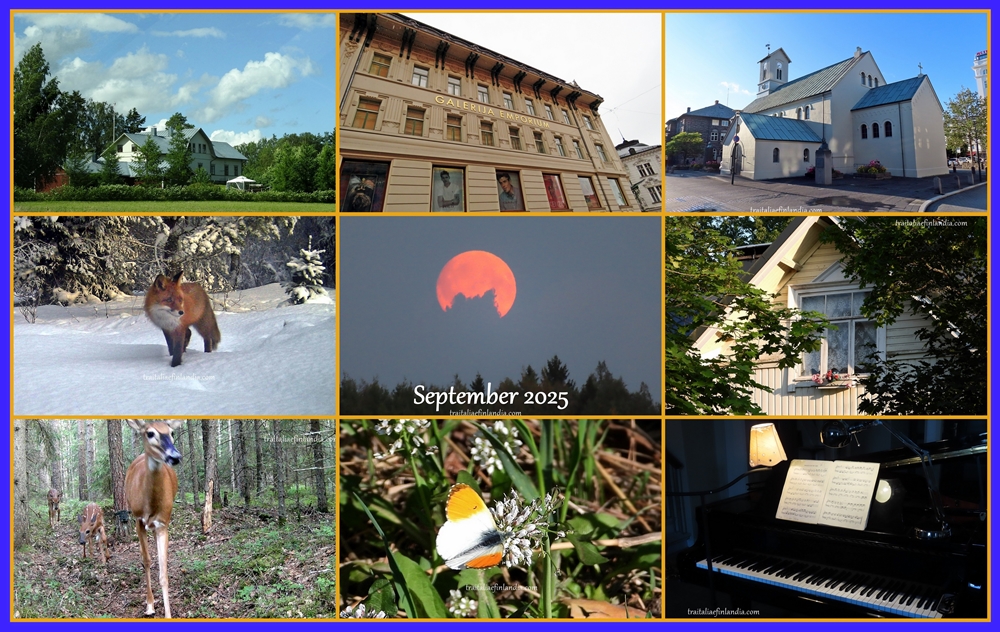
Un mese nelle mie foto.
Settembre in Finlandia è iniziato come Agosto: caldo e piacevole. Le temperature hanno raggiunto sovente i 25 gradi pomeridiani, senza piogge e senza vento. Ancora adesso a fine mese siamo al di sopra delle medie stagionali, ma finalmente sono arrivate anche le piogge, poichè eravamo in debito di acqua.
In Italia il tempo e’ stato altalenante con ancora caldo e intermezzi temporaleschi. La brutta notizia di questo periodo che riguarda proprio la zona di Verona, e’ che si sono avuti alcuni focolai di una febbre tropicale chiamata Chikungunya, portata dalle zanzare, nella fattispecie le “tigre” (Aedes albopictus). Naturalmente si tratta di una grossa novita’, poiche’ nel nord Italia non abbiamo mei avuto in passato queste malattie e nemmeno queste zanzare – sono arrivate ad iniziare dagli anni ’90. Le amministrazioni provvedono regolarmente alla disinfestazione comunque. Per fortuna questa febbre non si trasmette da persona a persona. Questa e’ una delle conseguenze evidenti del cambiamento climatico in atto.
Agosto e settembre sono i mesi dei raccolti delle messi in Finlandia. Grano, avena, orzo e segale vengono mietuti in questo periodo. Quest’anno il raccolto e’ stato piu’ o meno abbondante a seconda delle zone: le intense piogge di giugno non hanno giovato.
Adesso le giornate si sono accorciate di parecchio e dopo l’equinozio alla nostra latitudine saremo sempre in debito di minuti.
La stagione e’ entrata in una nuova fase: i boschi a poco a poco ingialliscono e qualche giorno ventoso fa cadere anzitempo le foglie dagli alberi; certe mattine abbiamo la presenza della sottile nebbiolina autunnale, segno che l’aria e’ molto piu’ umida. Gli animali sono dediti ad altre occupazioni: gli uccelli che si preparano a partire si stanno radunando in gruppi, con lo scopo di aiutare i giovani e non disperdersi; quelli che rimangono gia’ cercano posti dove trovare cibo per l’inverno. I mammiferi del bosco la cui stagione dell’accoppiamento inizia adesso, come cervi, caprioli e alci, sono in gran movimento. Coloro che si metteranno a dormire invece sono preoccupati di fortificarsi e di trovare una tana consona.
Questa e’ anche la stagione dei funghi. Per la verita’ i finferli si iniziano a trovare a fine luglio e ce ne saranno ancora fino a fine ottobre, anche perche’ non deperiscono facilmente e non sono attaccati da lumachine o animaletti come accade invece ai porcini. Quest’anno i boschi erano letteralmente pieni di finferli: Risto ha detto che non occorreva cercarli, erano loro che ti venivano incontro.
Anche i frutti di bosco sono stati abbondanti, quest’anno. Io ho fatto grandi quantita’ di marmellata di lamponi e stipato nel freezer molti chili di mirtilli per godermeli nel porridge.
E’ bellissimo andare per boschi nelle tiepide giornate settembrine quando il vento accarezza gentilmente gli alberi e l’unico rumore che si sente e’ il fruscio delle foglie. E’ molto rilassante. D’altra parte adesso i boschi sono silenziosi: non come a primavera quando gli uccelli fanno i loro concerti. Adesso l’unico richiamo udibile e’ il pigolio dei Codibugnoli che spostandosi in gruppi, si chiamano in continuazione l’un l’altro.
Fra le notizie del mese: il giorno 8 settembre in Finlandia si festeggia la Giornata Nazionale del “lukutaito”, cioe’ della capacita’ di leggere. Non e’ proprio la giornata della lettura, ma proprio del leggere capendo cio’ che si legge, al fine di farsi un’opinione, di imparare, di capire istruzioni etc… Tutte le Giornate dedicate alla consapevolezza di qualche argomento sono importanti e questa e’ fra quelle che a me interessano maggiormente.
Altre notizie spicciole: in Finlandia vivono 13 specie diverse di pipistrelli, di cui la piu’ diffusa e’ il Pohjanlepakko. Mi e’ capitato di verne qualcuno anche questa estate. Quando scende il buio gli uccelli invariabilmente dormono: gli unici a volare sono i pipistrelli.
Annoveriamo anche 500 tipi diversi di cimici o pulci.
Nel 2024 in Finlandia erano presenti 492 auto ogni 1000 abitanti.
La Finlandia e’ una grande produttrice ed esportatrice di cumino: il 25-30% della produzione mondiale viene da qui. Non vi sorprenda: avere il sole per 23 ore consecutivamente piace molto ad alcuni tipi di piante.
Nel 2024 sono stati emessi oltre 11.000 permessi di soggiorno a scopo lavorativo.
Quasi un quarto degli abitanti di Helsinki sono stranieri.
Ben il 75% delle piante al mondo ha bisogno dell’impollinazione per riprodursi.
Grazie per le vostre visite al mio blog, buon mese di ottobre e benvenuti ai nuovi followers!
A Month in my Photos.
September in Finland started like August: warm and pleasant. Afternoon temperatures often reached 25 degrees, with no rain and no wind. Even now, at the end of the month, we are above the seasonal averages, but finally the rains have also arrived, as we were in need of water.
In Italy the weather has been variable, with still some heat and occasional thunderstorms. The bad news during this period, w hich specifically concerns the Verona area, is that there have been some outbreaks of a tropical fever called Chikungunya, transmitted by mosquitoes, specifically the ‘tiger’ mosquitoes (Aedes albopictus). Naturally, this is a significant novelty, as in northern Italy we have never had these diseases or even these mosquitoes in the past – they started to arrive in the 1990s. Authorities regularly carry out disinfestation measures, however. Fortunately, this fever is not transmitted from person to person. This is one of the evident consequences of ongoing climate change.
August and September are the months for harvesting crops in Finland. Wheat, oats, barley and rye are harvested during this period. This year, the harvest has been more or less abundant depending on the area: the heavy rains in June did not help.
Now the days have shortened considerably, and after the equinox at our latitude we will always be in need of minutes.
The season has entered a new phase: the forests are gradually turning yellow and a few windy days cause the leaves to fall prematurely from the trees; on some mornings we notice the presence of a thin autumn mist, a sign that the air is much more humid. Animals are engaged in other activities: the birds preparing to migrate are gathering in groups to help the young and avoid scattering; those that stay are already looking for places to find food for the winter. The forest mammals whose mating season is starting now, such as deer, roe deer, and moose, are very active. Those that are going to hibernate, on the other hand, are concerned with strengthening themselves and finding a suitable den.
This is also the mushroom season. In fact, chanterelles start appearing at the end of July and there will still be some until the end of October, also because they do not spoil easily and are not attacked by snails or little creatures as happens with porcini mushrooms. This year the woods were literally full of chanterelles: Risto said that there was no need to look for them, they just came to meet you.
Forest fruits have also been abundant this year. I made large quantities of raspberry jam and stored many kilos of blueberries in the freezer to enjoy them in my porridge. It is wonderful to walk through the woods on warm September days when the wind gently caresses the trees and the only sound you hear is the rustling of the leaves. It is very relaxing. On the other hand, the woods are quiet now: not like in spring when the birds put on their concerts. Now the only audible call is the peeping of the Long-tailed Tits, which, moving in groups, constantly call to each other.
Among the news of the month: on September 8th in Finland, the National “lukutaito” Day is celebrated, that is: the ability to read. It is not exactly Reading Day, but specifically about reading and understanding what you read, in order to form your own opinion, to learn, to understand instructions, etc. All the Days dedicated to raising awareness of a certain topic are important, and this is among those that interest me the most.
Other small news: in Finland there are 13 different species of bats, the most common of which is the Pohjanlepakko. I happened to see a few of them even this summer. When darkness falls, birds invariably sleep: the only ones flying are bats.
We host also 500 different types of bugs or fleas.
In 2024, there were 492 cars per 1,000 inhabitants in Finland.
Finland is a major producer and exporter of cumin: 25-30% of the world’s production comes from here. Don’t be surprised: having the sun for 23 consecutive hours is very appealing to some types of plants.
In 2024 over 11,000 residence permits for work purposes were issued in Finland.
Almost a quarter of Helsinki’s residents are foreigners.
As much as 75% of the world’s plants need pollination to reproduce.
Thank you for visiting my blog, have a great month of October, and welcome to the new followers!
****
 Tra Italia e Finlandia
Lovely to read your beautiful descriptions of September. Sorry to hear about the disease-carrying mosquitoes. Unfortunately climate change is causing disruption everywhere and is getting worse. Here too we are seeing irregularities in the weather and the last three summers in Canada have produced our worse forest fires on record. I did not know that Finland produces so much cumin, but yes, all those hours of spring and summer sun are very helpful!
"Mi piace"Piace a 1 persona
Toujours très intéressantes, tes rétrospectives mensuelles. (et je regarderai maintenant la provenance de mon cumin !)
Bonne journée, Luisella
"Mi piace"Piace a 1 persona
non sapevo delle zanzare… e nemmeno del cumino…
è una spezia che praticamente non uso mai…
buon lunedì cara Luisella… 🤗🐞
"Mi piace"Piace a 1 persona
Effettivamente il cumino é una spezia esotica che si usa in preparazioni particolari. Buona giornata anche a te Cinzia! Grazie.
"Mi piace"Piace a 1 persona
Merci et bonne journée egalemént! 😉😆😆
"Mi piace"Piace a 1 persona
Thank you Lynette for your kind interest. Who knows what is coming on with the weather crisis… Happy Monday!
"Mi piace"Piace a 1 persona
Hello,
September has flown by! Beautiful images and mosaic!
It would be nice if all the flying bats would eat the mosquitos.
Take care, have a wonderful week!
"Mi piace"Piace a 1 persona
Sereno inizio di settimana! Da me è arrivato il freddooooooooo 🥶
"Mi piace"Piace a 1 persona
I like the darkening evenings of autumn, it’s time for candles! And it’s not hot anymore!
Thank you for this September, Luisella, ans have a sunny October!
"Mi piace"Piace a 1 persona
💖💖💖💖💖
"Mi piace"Piace a 1 persona
Grazie mille mia cara. 😊
"Mi piace"Piace a 1 persona
Thank you Susu. Wishing the same to you!
"Mi piace"Piace a 1 persona
Qui ancora alta pressione e tiepido. Ma presto arriverà… 😉 Grazie mille mia cara.
"Mi piace"Piace a 1 persona
Yes. Bats are so helpful! Thank you Eileen. Have a nice week ahead too!
"Mi piace"Piace a 1 persona
🌷
"Mi piace"Piace a 1 persona
Felice inizio di settimana💞
"Mi piace"Piace a 1 persona
Anche a te, grazie! 🌼🌸🌻
"Mi piace"Piace a 1 persona
…Luisella, I wish you an Outstanding October!
"Mi piace"Piace a 1 persona
And I wish you all the best, Tom! Glad to hear you are fine. Thank you.
"Mi piace""Mi piace"
Ciao forse mi sono persa… ma tu vivi in Finlandia tutto l’anno? cosa bellissima! mi trasferirei domani se potessi
"Mi piace"Piace a 1 persona
“Giornata Nazionale del “lukutaito”, cioe’ della capacita’ di leggere”.
Questa giornata dovrebbero istituirla ovunque, soprattutto di questi tempi!
"Mi piace"Piace a 3 people
Mi trovi d’accordissimo! Grazie del tuo pensiero.
"Mi piace"Piace a 1 persona
Ogni tanto vengo in Italia per vari motivi (come adesso che sono a VR), ma si..vivo in Finlandia.
Sul trasferimento…ti posso capire. 😉😊
"Mi piace""Mi piace"