**for English please scroll down**
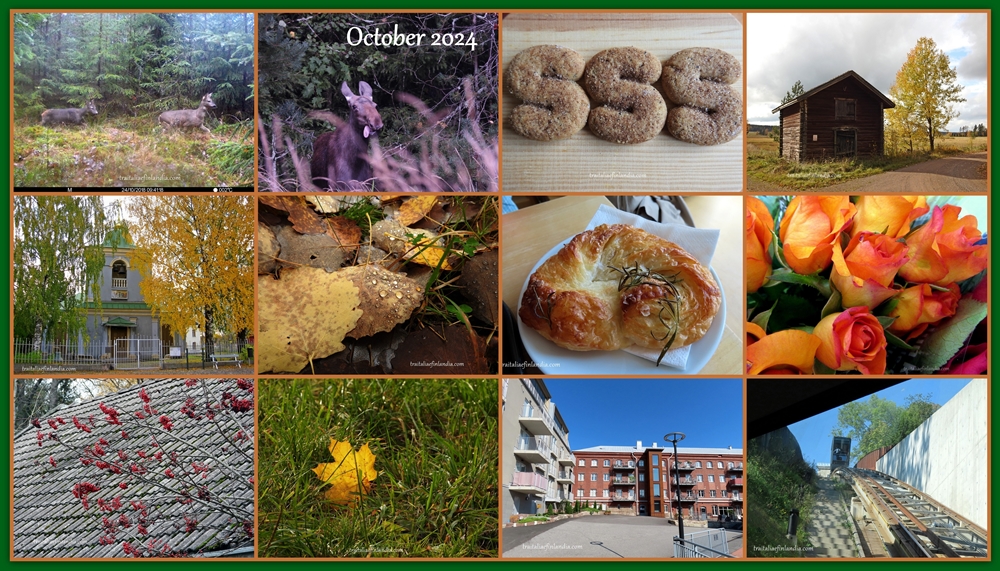 Un mese nelle mie foto.
Ottobre in Finlandia e’ stato proprio bello: un foliage sgargiane, poche piogge, molte giornate da trascorrere all’aria aperta. Le temperature sono state molto miti, anzi, eccezionalmente miti, come hanno detto i meteorologi, tanto che hanno sbaragliato tutti i records: questo ottobre e’ stato classificato come “poike…., definizione che si da’ ad un fenomeno che accade ogni 30 anni o meno.
In Italia invece ottobre e’ stato piovosissimo, totalmente diverso dall’anno scorso, quando sulla penisola incombeva ancora il caldo estivo. Quest’anno anche noi abbiamo preso moltissima pioggia nella nostra permanenza ottobrina a Verona. Purtroppo in molte localita’ si sono avuti fenomeni estremi, con inondazioni, feriti e vittime.
Tornando alla Finlandia, un aspetto che senz’altro la dice lunga sulla mitezza del corrente mese e’ il fatto che ci sono ancora molte foglie sugli alberi; solitamente entro meta’ ottobre cadono piu’ o meno tutte, complice anche qualche giorno ventoso, mentre adesso possiamo ancora ammirare chiome gialle, rosse e ruggine dappertutto, nonostante abbiamo gia’ avuto qualche notte vicina allo zero.
Il motivo di questo residuo calore che ha influenzato la Finlandia e’ stato l’affluire di aria mite dal sud Europa, spinta proprio dall’arrivo da ovest di perturbazioni a catena. Questa aria mite ha anche frenato leggermente le migrazioni degli uccelli, i quali solitamente aspettano vento favorevole per partire. Ancora adesso a fine mese ci volteggiano sulle teste stormi di anatre e oche selvatiche. Sembra invece che gli uccellini di taglia piccola siano partiti tutti: uno degli ultimi e’ il Pettirosso, mentre coloro che resisteranno fino a dicembre sono solitamente i Cigni.
Comunque le zanzare, le mie piu’ acerrime nemiche, sono finite. Va detto che qui in Finlandia vivono solo le zanzare “tradizionali”, cioe’ quelle che volano la sera e la mattina presto. Non abbiamo zanzare tigre o altre specie che portano malattie tropicali. Non ancora, almeno.
Parlando di foliage e di foglie colorate tanto graziose, va detto che quando cadono a terra nei giardini, pur costituendo humus e nutrimento per la terra, conferiscono un aspetto disordinato ai giardini stessi, per cui il verbo del mese e’ senz’altro: rastrellare! Ci sono opinioni contrastanti sulla necessita’ di rastrellare le foglie in autunno: alcuni dicono che e’ meglio lasciarle, ma noi abitando praticamente in mezzo al bosco ne abbiamo inumerevoli e preferiamo toglierle di mezzo. Le spostiamo di poco: tornano nel bosco da cui sono arrivate.
Le giornate si sono accorciate sensibilmente e con il cambio dell’ora si vede bene la differenza. Adesso e’ il momento di tornare a godersi il calore di casa, di coltivare gli interessi adatti alla stagione e di mangiare cibi leggermente piu’ ricchi e soprattutto caldi, per il benessere del corpo.
Tra le notizie del mese quella che ha fatto piu’ scalpore e ha sollevato un mezzo scandalo, e’ stato il taglio di una porzione di bosco fatto da una grande azienda forestale multinazionale, che ha danneggiato seriamente l’ambiente circostante. Mi spiego: nel bosco in questione scorre un ruscello nel quale vivono centinaia di Cozze d’acqua dolce (Margaritifera margaritifera), molluschi protetti e quasi estinti in molte aree d’Europa; tagliando gli alberi e’ venuta a mancare l’ombra necessaria alla sopravvivenza dei molluschi. Il danno fatto e’ consistente e gli ambientalisti si sono dati da fare per salvare il maggior numero di esemplari possibile trasportandoli in altri fiumi nelle vicinanze, ma comprensibilmente non si sa se riusciranno a sopravvivere. L’azienda forestale in questione si e’ difesa, ma il processo va avanti e vedremo come si concludera’. Per i finlandesi cosi’ attenti all’ambiente questo e’ stato un avvenimento di cui parlare, poiche’ si dubita della buona fede dell’azienda forestale.
Molti di voi si chiederanno perche’ questi molluschi siano protetti: le cozze d’acqua dolce si nutrono delle impurita’ dell’acqua in cui vivono, filtrandola, cosicche’ tutti gli esseri viventi che popolano quell’area ne beneficiano. Queste cozze vivono in simbiosi con i pesci della specie dei salmonidi e possono vivere addirittura 200 anni. Sono preziose perche’ filtrano fino a 50 litri d’acqua ogni giorno. La scomparsa di questi molluschi dall’ecosistema provoca la scomparsa di molti altri esseri viventi dallo stesso ecosistema. (Fonte: Metsähallitus).
A seguito di questo avvenimento, sul giornale sono apparse le valutazioni del “prezzo” di alcuni animali: una Cozza d’acqua dolce vale 600 euro; una Volpe artica 7400 euro; una Foca del Saimaa 9000 euro; uno Scoiattolo 1000 euro.
Altra notizia concernente la protezione dell’ambiente (a cui non tutti gli italiani sono sensibili!) e’ che la Finlandia ha chiesto ufficialmente che Putin venga processato oltre che per crimini di guerra anche per danni ambientali.
Un anniversario importante: nel 1994, cioe’ 30 anni fa, la Finlandia entrava a far parte della UE. Anche allora assieme alla Svezia.
Per gli appassionati: a Verona ogni novembre si svolge una importantissima fiera che richiama visitatori da molte parti del mondo: la Fieracavalli. A Helsinki si e’ appena colcluso l’annuale International Horse Show.
Grazie della vostra presenza, cari lettori e benvenuti ai nuovi followers!
Buon mese di Novembre e felice festa di Halloween a chi festeggia domani sera!
A Month in my Photos.
October in Finland was really beautiful: bright foliage, little rain, many days spent outdoors. The temperatures were very mild, actually exceptionally mild, as meteorologists said, so much so that they broke all records: this October was classified as “poike…., a definition given to a phenomenon that occurs every 30 years or less.
In Italy, on the other hand, October was very rainy, totally different from last year, when the summer heat was still looming over the peninsula. This year we also had a lot of rain during our October stay in Verona. Unfortunately, in many places there were extreme weather phenomena, with floods, injuries and victims.
Going back to Finland, one aspect that certainly says a lot about the mildness of the current month is the fact that there are still many leaves on the trees; usually by mid-October they more or less all fall, also thanks to a few windy days, while now we can still admire yellow, red and rusty foliage everywhere, despite the fact that we have already had a few nights close to zero.
The reason for this residual heat that has influenced Finland was the result of mild air from southern Europe, driven precisely by the arrival of chain disturbances from the west. This mild air has also slightly slowed down the migration of birds, which usually wait for favorable winds to start. Even now, at the end of the month, flocks of wild ducks and geese are flying over our heads. It seems instead that all the small birds have left: one of the last is the Robin, while those who will resist until December are usually the Swans.
However, the mosquitoes, my worst enemies, are gone. It must be said that here in Finland only the “traditional” mosquitoes live, that is those that fly in the evening and early in the morning. We do not have tiger mosquitoes or other species that carry tropical diseases. At least not yet.
Speaking of foliage and such pretty colored leaves, it must be said that when they fall to the ground in the gardens, even though they constitute humus and nourishment for the earth, they give a messy look to the gardens themselves, so the verb of the month is definitely: rake! There are conflicting opinions on the need to rake leaves in autumn: some say it is better to leave them, but since we practically live in the middle of the woods we have countless of them and we prefer to get rid of them. We move them a little: they go back to the woods from which they came.
Daylight has become noticeably shorter and with the time switch to wintertime you can clearly see the difference. Now is the moment to return to enjoying the warmth of home, to pursue interests suited to the season and to eat slightly richer and above all warmer foods, for the well-being of the body.
Among the news of the month, the one that caused the most stir and raised a bit of a scandal was the felling of a portion of woodland by a large multinational forestry company, which seriously damaged the surrounding environment. Let me explain: in those woodlands flows a stream in which hundreds of Freshwater Pearl Mussels (Margaritifera margaritifera) live: they are protected molluscs almost extinct in many areas of Europe; by cutting down the trees, the shade necessary for the molluscs to survive was lost. The damage done is significant and environmentalists have worked hard to save as many specimens as possible by transporting them to other nearby rivers, but understandably it is not known whether they will be able to survive. The forestry company in question has defended itself, but the legal action is ongoing and we will see how it ends. For the environmentally conscious Finns, this was an event to talk about, as the good intentions of the forestry company is questioned.
Many of you will wonder why these molluscs are protected: freshwater mussels feed on the impurities of the water they live in, filtering it, so that all living things in the area benefit. These mussels live in symbiosis with salmonid fish and can live up to 200 years. They are valuable because they filter up to 50 liters of water every day. The disappearance of these molluscs from the ecosystem causes the disappearance of many other living things from the same ecosystem. (Source: Metsähallitus).
Following this event, the HS newspaper published valuations of the “price” of some animals: a Freshwater Mussel is worth 600 euros; an Arctic Fox 7,400 euros; a Saimaa Seal 9,000 euros; a Squirrel 1,000 euros.
Another piece of news concerning environmental protection (which not all Italians are sensitive to!) is this: Finland has officially requested that Putin be tried not only for war crimes but also for environmental damage.
An important anniversary: in 1994, that is 30 years ago, Finland joined the EU. Back then, too, together with Sweden.
For enthusiasts: every November in Verona a very important fair takes place that attracts visitors from many parts of the world: Fieracavalli. The annual International Horse Show has just ended in Helsinki.
Thank you for your presence, dear readers, and welcome to the new followers!
Happy November and happy Halloween to those celebrating tomorrow night!
****
 Tra Italia e Finlandia
I am not shocked at the behaviour of the forestry company. They do these things everywhere and once it’s done, the damage can take decades to repair. It’s no surprise that we are seeing the results of climate change in our warmer winters. Greed wins over everything. Ugh.
"Mi piace"Piace a 1 persona
Quando si modifica l’ambiente naturale, anche un minimo particolare può destabilizzare l’intero ecosistema. Tutto ciò non sempre viene valutato “prima”, ma ci si rammarica solamente “dopo”.
"Mi piace"Piace a 1 persona
Purtroppo è così.
"Mi piace"Piace a 1 persona
I agree. Greed wins over everything. How sad.
"Mi piace"Piace a 1 persona
Belle queste foto! Ottobre in Puglia è stato più come in Finlandia, vuole dire completamente diverso da quello del nord: poche piogge, molto sole, addirittura la gente va ancora al mare. :)))
"Mi piace"Piace a 1 persona
October has been truly a beautiful and warm month. Sunshine and ruska ❤
"Mi piace"Piace a 1 persona
Hello,
Your October images are lovely. Yes, it seems the forestry dept can not be trusted, very sad.
Take care, have a great day!
"Mi piace"Piace a 1 persona
…Luisella, I wish you a Notable November.
"Mi piace"Piace a 1 persona
I very much like your October-overview and in many aspects, it resembles the October where I live.
As for the rain in Italy, well we had the bad luck to experience a bit of it too.
Concerning the felling of a portion of the wood, that you described …. well I guess it is everywhere the same, unfortunately. And these big companies don‘t care -they pay the fines, but the damage is done….
Kindest regards,
Christa
"Mi piace"Piace a 1 persona
a nice and detailed overview of the month of October
greetings
"Mi piace"Piace a 1 persona
A digression about freshwater molluscs: Warsaw waterworks use Unio crassus, (thick shelled river mussel) to monitor the water quality. They feed feed on the organic matter in the water, and close their shells when the water is polluted. The degree of shell dilation in constantly monitored and if it falls below a certain limit this means there is a problem with the water quality.
"Mi piace"Piace a 1 persona
Your weather is mirroring ours, overall the temps have been warmer and the leaves are hanging on 😊. Those are amazing little mussels, I hope they survive!
"Mi piace"Piace a 1 persona
Thank you very much, Belinda.
"Mi piace"Piace a 1 persona
That’s fantastic to hear! Well done. Thanks for sharing.
"Mi piace""Mi piace"
Thank you Willy. 😊
"Mi piace""Mi piace"
Thank you very much for your kind comment. I do agree with your considerations. Unfortunately this is it.
"Mi piace"Piace a 1 persona
Thanks. I wish the same to you, readily!
"Mi piace""Mi piace"
Thank you very much Eileen. Enjoy your evening!
"Mi piace"Piace a 1 persona
Yes, I biked a lot in the ruska. 😃
"Mi piace"Piace a 1 persona
Si, immagino che il mare sia anche più bello adesso con meno turisti. Grazie mille Corinna.
"Mi piace""Mi piace"
Beau mois de novembre à vous aussi. 🌺
"Mi piace"Piace a 1 persona
Merci. 👋😊
"Mi piace""Mi piace"
I walked with the dog 🙂
"Mi piace"Piace a 1 persona
This is great – a lovely insight into a far away land (I’m in Australia!)… our days are getting longer here… out of curiosity, how many daylight hours does Finland get in the middle of winter? Linda 🧡
"Mi piace"Piace a 1 persona
Thank you Linda for stopping by. On the winter equinox in the south of Finland we have six daylight hours. Naturally hours decrease as you travel northbound.
"Mi piace"Piace a 1 persona
Wow… that’s not a lot of sunshine!! But I’m guessing it reverses in summer… it’s so fascinating! Thank you, xx
"Mi piace"Piace a 1 persona
Yes, in summer we have 22 hours of daylight! 😄
"Mi piace"Piace a 1 persona
Oh gosh – somehow that seems even harder to deal with!
"Mi piace"Piace a 1 persona
You just get accustomed…😉
"Mi piace"Piace a 1 persona
👏🥰👏
"Mi piace"Piace a 1 persona