**for English please scroll down**
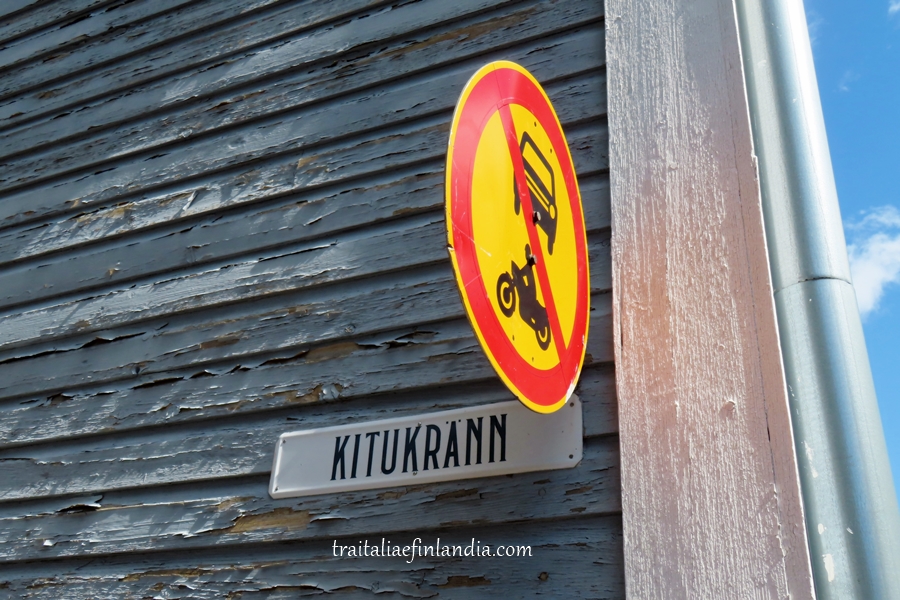
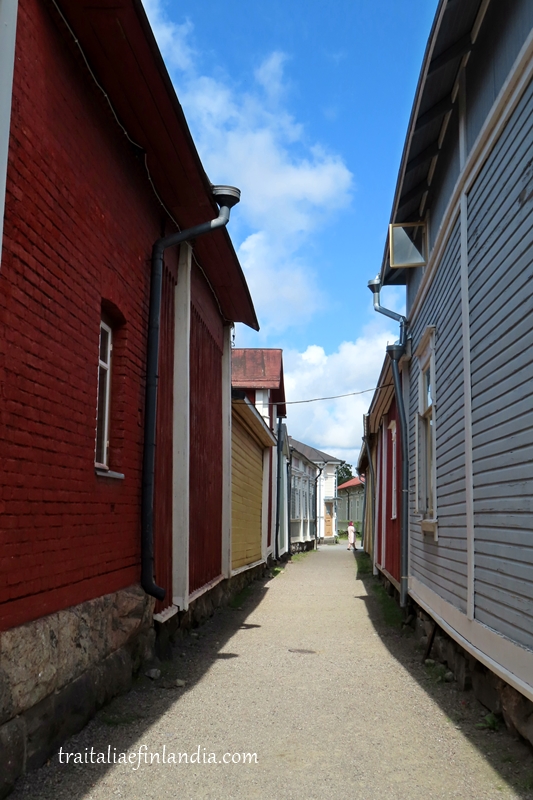
Kitukränn e’ il nome delle strada piu’ stretta della Finlandia. O meglio: del percorso piu’ stretto che ha la definizione di “strada”; al di sotto di Kitukränn ci sono solo vicoli.
E’ lunga sessanta metri e larga circa due. Il traffico che vi e’ permesso e’ solo pedonale e ciclabile.
Kitukränn si trova nel centro storico della bella citta’ di Rauma, situata sul Golfo di Botnia, di cui abbiamo parlato nello scorso post. Citta’ portuale e fluviale, Rauma vanta un centro storico che e’ il maggior complesso unitario di edifici in legno meglio conservati di tutti i Paesi nordici.
Rauma vanta altresi’ ancora oggi dei cantieri navali attivissimi, dove si costruiscono imbarcazioni per operatori crocieristici internazionali, nonche’ per l’esercito.
Ecco Kitukränn:

L’avviso in lingua ottocentesca significa: “Sporcare e’ proibito. Chiunque sara’ sorpreso a farlo verra’ multato di 20 marchi”. Il marco finlandese (markka) era la moneta in vigore prima dell’avvento dell’euro.
Il nome Kitukränn significa forse rachitico, cresciuto male, come certi alberi che non crescono dritti per mancanza di luce o nutrimento.
Kitukränn.
Kitukränn is the name of the narrowest street in Finland. Or rather: the narrowest path that has the definition of “street”; below Kitukränn there are only alleys.
It is sixty meters long and about two meters wide. The traffic that is allowed there is only pedestrians and cyclists.
Kitukränn is in the historic center of the beautiful city of Rauma, located on the Gulf of Bothnia, which we talked about in my previous post. A port and river city, Rauma boasts an old town that is the largest single complex of best-preserved wooden buildings in all the Nordic countries.
Rauma also boasts very active shipyards, where boats are built for international cruise operators, as well as for the army.
In the single shot: Kitukränn.
The notice in 19th-century language in the last photo means: “Littering is prohibited. Anyone caught doing so will be fined 20 marks.” The Finnish markka was the currency before the euro.
The name Kitukränn perhaps means stunted, poorly grown, like certain trees that do not grow straight due to lack of light or nourishment.
****
 Tra Italia e Finlandia
These details are what make communities unique and interesting.
"Mi piace"Piace a 1 persona
Yes, lovely details which mean knowledge as well. Thank you Lynette.
"Mi piace"Piace a 1 persona
Interesting curiosity, thanks for sharing. BTW I wonder whether 20 marks was a substantial sum of money at the time when the notice was put on the wall….
"Mi piace"Piace a 1 persona
…narrow for sure! Have a wonderful day, Luisella.
"Mi piace"Piace a 2 people
I wonder if Kitukränn is narrower than some streets I’ve seen in Japan!
"Mi piace"Piace a 1 persona
I don’t know how busy this “street” is, but I imagine that it would not be easy to have many pedestrians and bicyclists manoeuvering in there at the same time.
"Mi piace"Piace a 1 persona
🩵🩵
"Mi piace"Piace a 1 persona
Merci. 😊
"Mi piace""Mi piace"
Sure! 😄😄
"Mi piace"Piace a 1 persona
Absolutely not, Hien. 😃 It is neither narrower than certain streets in Italy. But this is it, here in Finland. 😉
"Mi piace""Mi piace"
Thanks. The same to you, Tom!
"Mi piace""Mi piace"
That is a good question. We can only argue that 20 markkaa must have been something at leat for some people, at that time. .
"Mi piace""Mi piace"
Actually, my husband, who is brilliant, found a converter: in 1870, 20 markaa were 121 current euros.
"Mi piace"Piace a 1 persona
Come sempre. è un post interessante e delizioso!
"Mi piace"Piace a 1 persona
Grazie. Come sempre, sei davvero gentile. 😊
"Mi piace"Piace a 1 persona
Felice giornata, Luisella cara
"Mi piace"Piace a 1 persona
Grazie Luisa e buon weekend! 😊
"Mi piace"Piace a 1 persona
Buon weekend anche a te 🌹❤️🌹
"Mi piace"Piace a 1 persona
Very interesting! Thank’s for sharing!
"Mi piace"Piace a 1 persona
Thank you Tom. Happy Sunday!
"Mi piace"Piace a 1 persona