*for English please scroll down*
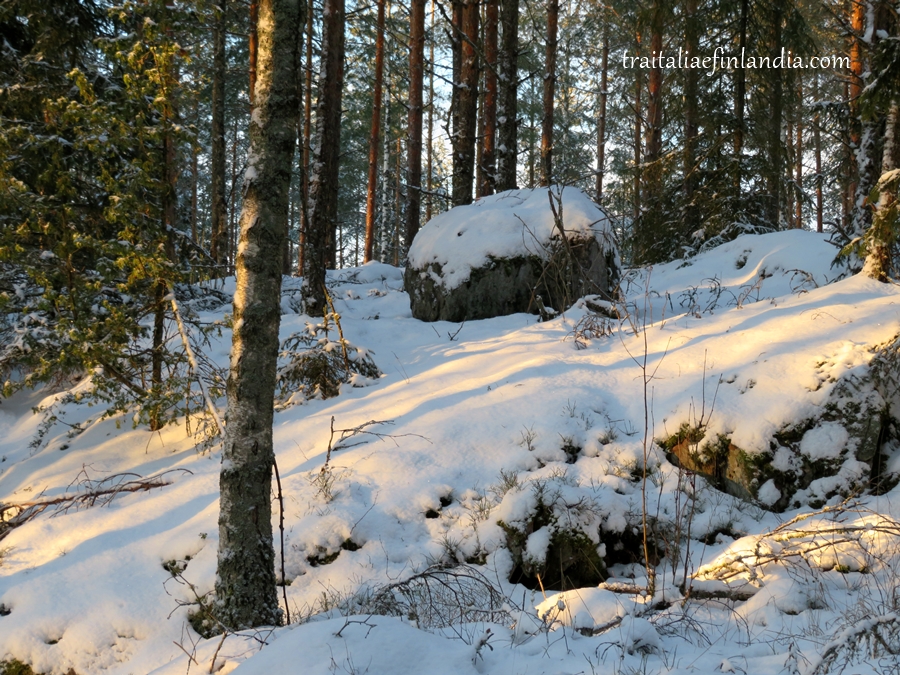
Il territorio del nord Europa è completamente disseminato di massi erratici, cioè di pietre di varia grandezza rimaste indietro dal ritiro dei ghiacci dopo l’ultima glaciazione circa 25000 anni fa.
Queste pietre ovviamente non si trovano soltanto nel nord Europa, ma anche nei ghiacciai di tutto il mondo, ad esempio quelli Alpini. Da noi in Finlandia si trovano un po’ ovunque, dato che non si è trattato del ritiro di un ghiacciaio isolato, ma del ritiro del ghiaccio da tutta la superficie del terreno esistente.
Di conseguenza, l’uomo ha avuto a che fare con queste pietre talvolta enormi in ogni ambiente: dai boschi, alle strade, alle aree urbane, alle campagne… ed ha dovuto adattarsi a conviverci. Talune pietre sono ragionevolmente piccole e si sono potute trasportare via quando erano d’impedimento alle attività umane, talaltre, a causa delle dimensioni e del peso, si sono dovute lasciare dove si trovavano. (Oggigiorno si possono far esplodere con piccole cariche di dinamite, quando si tratta ad esempio di costruire strade…)
Nelle foto di oggi alcuni esempi: nelle foto sopra vedete qualche masso erratico nei boschi, che non ostacola ed è solo pittoresco.
Nelle foto qui sotto: nel nostro orto ce ne sono alcuni che Risto ha pensato bene di far sprofondare, scavandoci attorno, non riuscendo a liberarsene in altro modo. Se i massi affiorano dal terreno anche poco, infatti, ostacolano lo sfalcio erba e la coltivazione dell’orto.


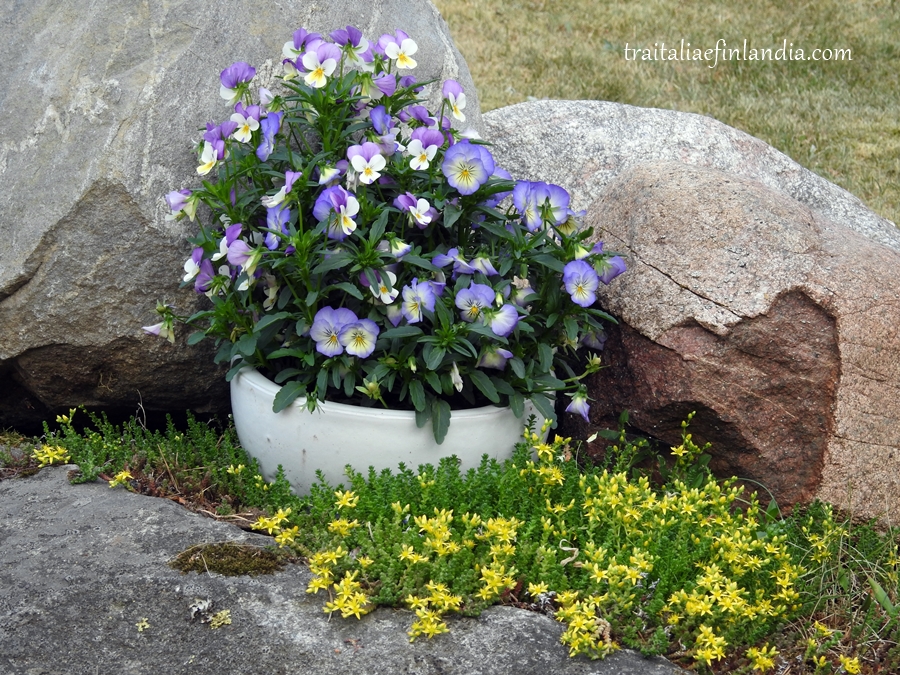
Infine: quando i massi erratici sono talmente grandi e irremovibili anche con pale meccaniche ed escavatori, se ne fa buon viso e si usano come decorazione:
CURIOSITA’: I massi erratici sono oggetto di leggende e superstizioni, data la loro origine per molto tempo sconosciuta. Non solo: quelli di dimensioni enormi che presentano pareti scalabili, sono oggetto di arrampicate sportive. Uno sport che si chiama: Sassismo.
Glacial Erratics.
The territory of northern Europe is abundantly dotted with erratic boulders, that is stones of various sizes left behind by the retreat of the ice after the last glaciation about 25,000 years ago.
These stones are obviously not only found in northern Europe, but also in glaciers all over the world, for example in the Alps. Here in Finland they are found practically everywhere, because it was not about the retreat of a isolated glacier, but of the retreat of the ice from the entire surface of the existing land.
Consequently, man has had to deal with these sometimes enormous stones in every environment: from the woods, to the streets, to urban areas, to the countryside… and has had to learn to live with them.
Some stones are reasonably small and could be transported away when they were an obstacle to human activities, others, due to their size and weight, had to be left where they were. (In case of major necessities, like road building, boulders can be detonated, nowadays).
In today’s photos some examples: in the photos above you see some erratic boulders in the woods, which are just picturesque.
In the photos below instead: in our garden Risto has caused a few boulders to sink down, by digging around them, unable to get rid of them in any other way. If the boulders emerge from the ground even slightly, in fact, they hinder the mowing of grass and the cultivation of the vegetable garden.
In my final shot: when erratic boulders are so large and unmovable even with mechanical shovels and excavators, we must surrender and use them as decoration.
A FUN FACT: Erratic boulders are the subject of legends and superstitions, given their origins which were unknown for a long time. Moreover: the biggest ones which have climbable walls are the subject of sport climbing. A sport called: Bouldering.
****
 Tra Italia e Finlandia
I thinks a little correction is in place here…. When people build houses in the valleys in the Alps, they often find these boulders as well in the underground… Those valleys are all formed by glaciers too.
I’ve often seen it in the alps on building sites.
"Mi piace"Piace a 1 persona
Buongiorno massoso Luisella
"Mi piace"Piace a 1 persona
Pretty
"Mi piace""Mi piace"
Superbes tes photos ainsi que les infos. Bonne jourtnée
"Mi piace"Piace a 1 persona
I see these here as well – not surprising since we’re between two mountain ranges with a lot of geological history.
"Mi piace"Piace a 1 persona
Buongiorno massiccio, Paola! 🙂 🙂 🙂
"Mi piace""Mi piace"
Actually, that’s true. My statement is too simple. 🙂
"Mi piace""Mi piace"
bella curiosità
"Mi piace"Piace a 1 persona
Thanks, Rudi.
"Mi piace""Mi piace"
Interessante. Ne abbiamo alcuni notevoli anche qui in Italia!
"Mi piace"Piace a 1 persona
💙
"Mi piace"Piace a 1 persona
ah bell’idea quella di sotterrarli…io ho una seconda casa in un paese ai piedi delle alpi che si chiama MASSINO (come piccolo masso) e in effetti esiste in paese un grosso masso erratico vicino a cui hanno fatto una fontana (e pure deturpato con una scritta politica..)
"Mi piace"Piace a 1 persona
😊
"Mi piace"Piace a 1 persona
Interesting post! The rock garden is pretty. I have heard and seen the rock climbers, bouldering is new to me. Take care, have a wonderful week!
"Mi piace"Piace a 1 persona
…the glaciers littered the Adirondacks with massive erratics too. I wish you a fabulous week, Luisella.
"Mi piace"Piace a 1 persona
Bellissimi. Hai visto cosa sono riusciti a fare gli Etruschi con i “massi” di tufo?
"Mi piace"Piace a 1 persona
Beautiful pictures – as always.
"Mi piace"Piace a 1 persona
Affascinante!
"Mi piace"Piace a 1 persona
Sono d’accordo. 😊👍
"Mi piace"Piace a 1 persona
Thank you so much, Tom! 😊
"Mi piace""Mi piace"
Grazie cav. 😊 Devo proprio andare a fare un giro nella Tuscia…
"Mi piace""Mi piace"
Thanks for your information. Have a nice week ahead too!
"Mi piace""Mi piace"
It is a rock garden indeed. Thank you Eileen. You are always so kind. I wish you all the best!
"Mi piace"Piace a 1 persona
Grazie Luisa per aver condiviso la tua esperienza. Buona serata!
"Mi piace""Mi piace"
Grazie Luisa. 👋😊
"Mi piace"Piace a 1 persona
Grazie Olga. 👋😊
"Mi piace""Mi piace"
Thanks for sharing this information. 😊
"Mi piace"Piace a 1 persona
Merci et bonne soirée à toi. 🌛
"Mi piace""Mi piace"
Bedankt en de rotstuinen kunnen me bekoren
"Mi piace"Piace a 1 persona
I think many people would be happy to have such beautiful rocks to decorate their gardens. They are quite expensive to buy and have delivered to one’s property. But I imagine that it’s frustrating to try to move them when they are in the way.
"Mi piace"Piace a 2 people
Yes, for instance in my garden we had to surrender and keep a couple of big ones. They are like icebergs: just the top is visible, but underground their mass can be enormous.
"Mi piace"Piace a 1 persona
Het is mij een genoegen dit te delen. 😊
"Mi piace"Piace a 1 persona
🙏🪨🙏
"Mi piace"Piace a 1 persona
Hello blogger, I enjoyed reading your post. I subscribed. See you often. Have a happy and bright day. ^^*
"Mi piace"Piace a 1 persona
Ich würde sie natürlich liegen lassen in meinem Garten.
Für viel Geld habe ich mir einen Findling in meinen Garten bringen lassen, ihn ein wenig oben bearbeitet, so dass eine Vogeltränke entstand und zwei drei Vögel aus Kupfer dazu gesellt.
Und ihr habt das alles umsonst und vergrabt die tollen Steine. *lol*
"Mi piace"Piace a 1 persona
Ah ah! Du hast mich zum Lachen gebracht! 😄😄😄
Wir haben diejenigen begraben, die ein Hindernis waren, aber wir haben noch ein paar größere.
"Mi piace"Piace a 1 persona
"Mi piace""Mi piace"
Foto von einem uralten analogen Foto 😉
"Mi piace""Mi piace"
Thank you.
"Mi piace""Mi piace"